





What Are the Cognitive Benefits of Chess for Preschoolers?
The honest answer is smaller and more specific than most chess marketing lets on. The best research on cognitive benefits of chess for preschoolers points to one clear finding, a boost in visuospatial working memory, alongside several null results in the same study, and researchers who study this topic professionally have gone on record saying it's unlikely chess makes a meaningful difference to a child's overall intelligence. That's not an argument against a preschool chess class. It's an argument for knowing what the research actually supports before you decide what to expect from one.
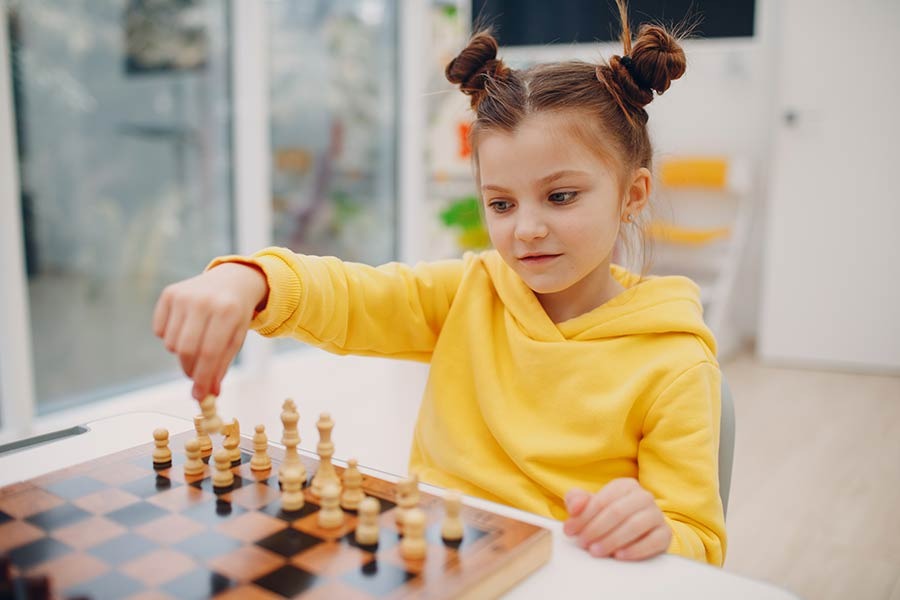
If you read our companion piece on Strong Roots' preschool chess program, you already know what a weekly chess session looks like for a three- or four-year-old at our Northridge school: one piece introduced at a time, mini-games before a full match, no scoreboard. That page kept the research to a single paragraph on purpose. This one is the deeper research picture, the studies behind the claims, what they actually measured, and where the evidence is thin instead of strong.
Parents deserve a straight answer on this, not a highlight reel. So here's what the science says about the cognitive benefits of chess for preschoolers, tier by tier, starting with the most direct evidence and working out to the more general claims.
What Does the Research Actually Say About Chess and Young Kids' Thinking Skills?
The most age-specific research on cognitive benefits of chess for preschoolers comes from a 2025 study of children ages five and six, and it found one significant result, not a sweeping list of them. Researchers compared children with at least six months of chess experience against non-players using a standard neuropsychological test battery, and the chess group came out ahead on a narrow, specific skill: visuospatial working memory. Everything else the researchers measured came back flat.
That's worth sitting with before moving on. A lot of chess marketing treats "cognitive benefits" as one big undifferentiated bucket, memory, focus, problem-solving, creativity, all improving together. The actual data doesn't support that picture. It supports a much narrower claim about the cognitive benefits of chess for preschoolers.
What Did the 2025 Visuospatial Working Memory Study Find?
Yakushina, Chichinina, and Dolgikh published this study in Frontiers in Psychology in 2025, comparing 44 chess-playing five- and six-year-olds against 44 non-players, all typically developing children. The chess players had a median of twelve months' experience playing twice a week for 40-minute sessions. Researchers used the NEPSY-II battery, a standard neuropsychological assessment for children, to test several distinct cognitive domains rather than one.
The chess group scored significantly higher on visuospatial working memory overall (p=0.05, right at the conventional threshold for statistical significance, not comfortably past it), on a spatial subscore specifically (p=0.04), and on a combined location-and-detail memory subscore (p=0.01). That last result was the strongest finding in the study.
Visuospatial working memory is the mental skill you use to hold a picture of where things are in space and how they relate to each other, which is exactly what a chess board asks a child to track: where each piece sits, what square it can move to next. It makes intuitive sense that kids who spend regular time on a chessboard would get measurably better at that specific skill. What's notable is that the study didn't find broader gains beyond it.
You can read the full study, including its methodology and complete results tables, at Frontiers in Psychology.
What Didn't the Study Find?
The same study tested inhibitory control, verbal working memory, a separate memory content-recall subscore, and cognitive flexibility, and found no statistically significant difference between the chess-playing group and the non-players on any of them (p=0.89, p=0.40, p=0.42, and p=0.47, respectively). Those are not borderline numbers. They're solidly null.
This is the part of the study that rarely makes it into a chess program's marketing copy, and it's worth stating plainly because it changes what a parent should reasonably expect. This particular research does not show that chess made five- and six-year-olds better at self-control, at holding verbal information in mind, or at flexibly switching between ways of thinking. It showed one specific spatial-memory gain and left the rest of the cognitive map unchanged, at least in this sample.
There's also a design limit worth naming. This was a cross-sectional study, meaning researchers compared two already-existing groups of kids rather than randomly assigning some to play chess and others not to. Children who were already enrolled in chess classes might differ from non-players in other ways, family background, prior interests, how their parents structure enrichment time, that the study couldn't fully separate out from the effect of chess itself. That doesn't erase the finding. It does mean "correlation" is the more accurate word than "proof."
Does Chess Improve Academic Performance?
On the academic side of the cognitive benefits of chess for preschoolers question, the research shows a real but modest effect, not the dramatic score jumps a lot of marketing implies. The most cited evidence for a chess-and-academics link comes from a 2016 meta-analysis that pooled 24 separate studies covering 5,221 children, most of them school-age rather than preschool-age specifically. The overall effect was moderate: an effect size of g=0.34, with math showing the stronger link at g=0.38 and reading a more modest g=0.25.
Effect sizes like these are useful for comparing across studies, but they don't translate directly into "your child's grades will go up by X." What they tell you is that, averaged across the studies reviewed, chess-trained kids outperformed comparison groups by a moderate amount on math and by a smaller amount on reading. Moderate is real. It's also a long way from "chess makes kids smarter."
What Does the Largest Chess Meta-Analysis Show?
Giovanni Sala and Fernand Gobet, both researchers at the University of Liverpool, published this meta-analysis in Educational Research Review, and it remains the largest, most cited synthesis of chess-and-cognition research available. Beyond the overall effect size, the authors found that the duration of chess instruction mattered: studies where children received roughly 25 to 30 or more hours of instruction showed a more reliable effect than shorter programs (p<.05 for the duration relationship itself).
That duration threshold matters for context. It's not a light dosage. Twenty-five to thirty hours of instruction adds up over many weeks or months of regular class time, well beyond a handful of introductory sessions. You can read the full meta-analysis, including the study-by-study breakdown, through Educational Research Review.
Why Do Researchers Say the Real Effect Might Be Smaller Than It Looks?
Sala and Gobet flagged their own biggest limitation themselves, and it's a significant one: almost none of the 24 studies in their meta-analysis compared chess against another active alternative activity. Most compared a chess group against a "no activity" control group, meaning the kids in the comparison group did nothing structured at all during that time.
That design choice can inflate an apparent effect. Any new, engaging activity, not just chess, tends to produce some improvement when measured against doing nothing, simply because the children are getting extra attention, structure, and novelty. Without an active control group (a comparison activity that's equally engaging but isn't chess, like checkers or a different enrichment class), it's hard to know how much of the measured benefit is specific to chess itself versus just the general effect of doing something structured and new.
The researchers were direct about this limitation in their own public writing. As Sala and Gobet put it in a piece for The Conversation, when chess is tested against an active alternative rather than nothing, "it shows no significant advantage" over that alternative. That's the authors of the field's biggest meta-analysis telling you, in their own words, not to over-read their own numbers on the cognitive benefits of chess for preschoolers.
Does Chess Help Kids With Patience and Emotional Regulation?
Patience and emotional regulation are usually folded into the same conversation as the cognitive benefits of chess for preschoolers, but the evidence here is a different kind, and it comes with an important asterisk: most of it is based on what parents and teachers report noticing, not on an independently measured behavioral outcome. That distinction matters more than it might sound like it does.
A 2023 survey of 774 parents of chess-playing children in Romania found that 41.6% named "impatience" as the single trait chess helped their child work through the most. Parents also rated chess highly for helping their child develop positive emotions (an average of 4.38 out of 5) and manage negative ones generally (4.20 out of 5). The same survey found 84.6% of parents said their child made new friends through chess.
Those numbers sound encouraging, and they might well reflect something real. But this was an online survey using a non-standardized questionnaire, filled out by parents who had already enrolled their kids in chess, a group that's likely to view chess favorably to begin with. It measures what parents perceived, not a clinical or behavioral measurement of a child's actual patience before and after. You can read the full survey at Frontiers in Psychology.
What Do Parents Report Noticing?
Parents in that survey specifically flagged impatience as the emotional trait chess seemed to help most with, more than any other named trait. That lines up with an intuitive explanation: chess is a slow game by nature, and a child who wants to move immediately has to learn to wait for a turn, think before acting, and sit with the discomfort of not being able to rush the process. Whether that patience carries over to non-chess settings (waiting for a turn at dinner, sitting through a long car ride) is exactly what this kind of self-report survey can't tell you on its own.
Why Did Teachers and Parents Disagree in One Study?
A separate 2025 study of 40 children ages eight to twelve found a genuine split between what teachers observed and what parents observed after the same four-month chess program. Teachers, using a standardized executive-function questionnaire (the BRIEF-2), reported statistically significant improvement in the chess group's emotional regulation and cognitive flexibility, with the largest gains in cognitive flexibility (a nine-point-plus improvement, p=.006). Parents, rating the same children on the same questionnaire, reported no statistically significant differences at all.
That gap is a genuinely useful data point, not a contradiction to explain away. It suggests that whatever behavioral change chess produced showed up more clearly in the structured, observed environment of school than it did at home, where routines, expectations, and a parent's baseline sense of their own child are all different. The honest takeaway: whether chess "helps with patience" can depend heavily on who's doing the observing and where. Full study details are available through Revista de Psicología.
Is the "Chess Makes Kids Smarter" Claim Backed by Research, or Is It Hype?
Both halves of that question are true at the same time when it comes to the cognitive benefits of chess for preschoolers, and that's the most important sentence in this article. Real, peer-reviewed research does find measurable cognitive and academic effects from chess instruction. Those effects are also smaller, narrower, and more conditional than most marketing suggests.
The clearest, most direct statement on this comes from the researchers behind the field's largest meta-analysis, writing for a general audience rather than an academic journal. In a piece for The Conversation, Sala and Gobet wrote plainly that "it is unlikely chess has a significant impact on overall cognitive ability." They pointed to a large British study of nearly 4,000 children that found chess instruction had no effect on attainment in mathematics, literacy, or science. And they noted again that when chess is measured against an active alternative activity rather than no activity at all, its advantage largely disappears.
That's not an anti-chess conclusion. It's a precise one. Chess appears to build specific skills, like visuospatial working memory, under specific conditions, like sustained instruction over many hours. It is not, on the evidence currently available, a general intelligence booster or a guaranteed academic shortcut. Anyone telling you otherwise is going further than the research supports. You can read the researchers' own summary at The Conversation.
What Age Do the Cognitive Benefits of Chess for Preschoolers Start Showing Up?
Preschool and kindergarten-age evidence exists, but it's thin and narrow compared to what's available for older kids. The one study that specifically measured children ages five and six found a single significant gain, visuospatial working memory, with everything else tested coming back null. That's essentially the entire preschool-age-specific evidence base for cognitive benefits of chess for preschoolers as it currently stands in the peer-reviewed literature this article draws from.
The stronger, more consistent evidence comes from studies of older, primary-school-age children, roughly ages eight to twelve, often after considerably more instructional time than a weekly preschool enrichment class provides. The teacher-reported executive-function gains discussed earlier came from an eight-to-twelve age group receiving 48 hours of instruction over four months, three hours a week, a meaningfully higher dosage than a single 30- to 40-minute weekly preschool session.
None of this means chess is pointless before age eight. It means the research base for younger kids is smaller and narrower than the research base for older kids, and a parent comparing the two age groups should expect a correspondingly more modest, more specific set of claims for the preschool years.
Do the Benefits Apply to a Casual Weekly Chess Class, or Only Competitive Programs?
The research behind the cognitive benefits of chess for preschoolers is specifically about structured, sustained instruction, not casual or occasional play, and that distinction has real implications for a once-a-week preschool enrichment class. Recall the duration finding from the Sala and Gobet meta-analysis: studies with roughly 25 to 30 or more hours of instruction showed a more reliable effect than shorter ones. A weekly 30- to 40-minute preschool session adds up to that range only after many months of consistent attendance.
A separate 2025 review looking specifically at how chess is taught in different educational systems found something directly relevant here. In Western educational contexts, where chess typically functions as an extracurricular or hobby class, the same format as a weekly preschool enrichment session, the review found benefits concentrated in social skills and logical thinking, describing a "limited effect on long-term cognitive improvement." In Asian educational systems, where chess is often a compulsory, curriculum-embedded subject with far more instructional hours built in, the same review reported stronger and more consistent math and reading gains.
That's an honest, useful distinction for a parent to know before enrolling a child in any weekly chess program, ours included: a once-a-week extracurricular class sits on the lighter-dosage end of the evidence spectrum. It's a reasonable, low-pressure introduction to a skill and a game. It is not, based on the research reviewed here, positioned to produce the stronger academic gains associated with the higher-hour, curriculum-integrated model. You can read that full review through Frontiers in Psychology.
How Does Strong Roots Approach Chess Research Honestly?
We'd rather tell parents the true shape of the evidence than the flattering version of it. That's why this page exists as a companion to our program page rather than folded into it: the research on cognitive benefits of chess for preschoolers is genuinely mixed, narrower than most marketing suggests, and worth knowing before you decide what to expect from a weekly class.
What we can say plainly, based on what the research does show, is that a weekly, age-appropriate chess class gives a child repeated practice at a few specific things: holding a mental picture of where pieces sit on a board, waiting through a slower-paced turn-based activity, and sitting with a game that doesn't move as fast as they'd like. Those are real, if modest, and they're the honest version of the cognitive benefits of chess for preschoolers, not the same claim as "chess will make your child smarter."
At Strong Roots Preschool, chess is one weekly enrichment class inside a full CCRC-licensed preschool day at 9054 Darby Ave in Northridge, California (license #195700760), alongside Armenian language, math, arts, STEAM, and Bible study enrichment. It's taught piece by piece, non-competitively, the way our program page describes in more detail. If you'd like to see a session in person and ask an instructor questions directly, you can schedule a tour or call (323) 990-8181.