





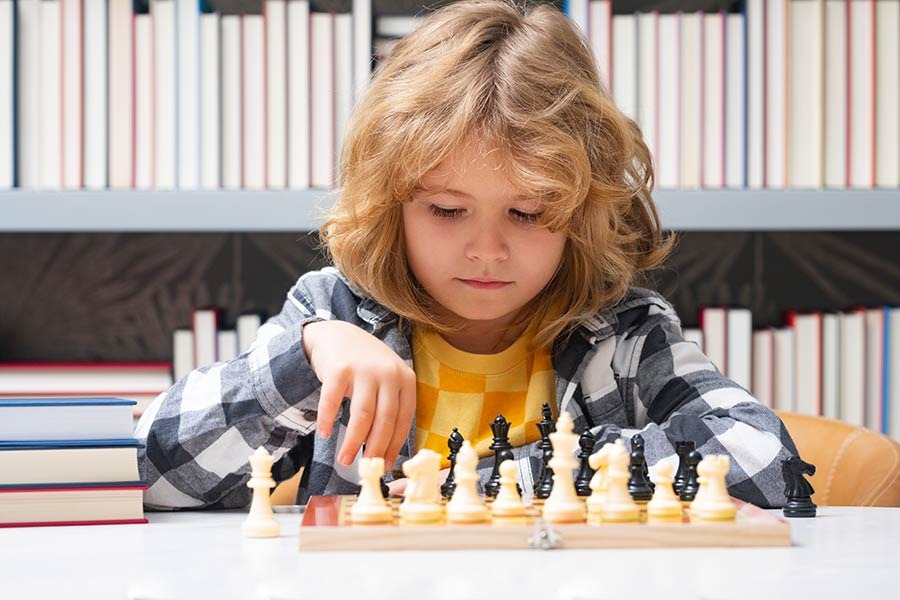
What Makes Strong Roots' Preschool Chess Program Different?
If you're trying to decide whether a preschool chess program is worth adding to your child's week, here's the short version: it's worth it when the class is actually built around how a three- or four-year-old learns, not just a shrunk-down version of adult chess. That's the whole idea behind the preschool chess program at Strong Roots Preschool in Northridge, California. Chess here isn't a bolt-on extra squeezed into an already busy daycare day. It's one weekly enrichment class woven into a full day of licensed early childhood care, taught piece by piece so a young child can genuinely keep up instead of getting lost in rules built for grown-ups. If you've already sat through a chess class that felt rushed or over adults' heads for your toddler, this is meant to be the opposite of that experience.
This page walks through what actually happens in a Strong Roots chess session: how a child moves from holding a single pawn to playing a simplified mini-game, what age most kids are ready to start, and how chess fits alongside the school's other weekly offerings (Armenian language, math enrichment, arts, STEAM, and Bible study) inside one CCRC-licensed preschool program at 9054 Darby Ave in Northridge.
This is written for parents in Northridge and the surrounding San Fernando Valley who are already comparing preschools, or already enrolled, and trying to figure out whether the chess add-on is worth a look. If you're picturing a rigid tutoring session with a clock and a scoresheet, that's not what a preschool chess program looks like at this age, and it's not what Strong Roots runs. What follows is a plain description of the age range, the teaching method, and how the class sits inside the rest of the week, not a sales pitch dressed up as an FAQ.
What age can kids start learning chess at Strong Roots?
Most children are ready to begin structured chess lessons somewhere between ages three and five, and that's the window Strong Roots' program is built around. This isn't a Strong Roots-only guess. It lines up with how established preschool chess programs elsewhere structure their own age ranges: The Knight School's Little Geniuses classes run ages 3 to 5, Little Chess Masters markets to ages 3 through 6, and Story Time Chess starts at age 3 and up.
Some children can start handling pieces and recognizing the board even earlier, around age two or three, but that usually takes a lot of hands-on adult guidance rather than a real lesson format. Structured, lesson-based chess instruction, the kind where a child follows a sequence and starts to retain what a piece does from one week to the next, is what most dedicated programs (Strong Roots included) target for the three-to-five range, according to guidance on teaching chess to young children. A four-year-old who has never seen a chessboard before is not behind. Three and four are, if anything, the exact ages this kind of preschool chess program is designed for.
Parents sometimes worry their child is either too young or already "missed the window." Neither is usually true. If your child is in the three-to-five range and can sit through a short, playful activity, they're within the age band this class is built for.
It's also worth knowing that Strong Roots' enrichment offerings, chess included, serve families across a broad age range, roughly ages 2 through 13 across the school's full set of programs. The chess class specifically is built around the preschool age window, but that's a starting point, not a hard cutoff. A family with kids spanning a few different ages can generally expect the same weekly rhythm of enrichment classes, just tailored to where each child actually is developmentally.
What does a weekly chess class look like for a 3- or 4-year-old?
A weekly chess class for a preschooler does not look like two adults hunched over a board in total silence. It looks like a short, structured, playful session where one piece gets introduced at a time, mini-games replace a full match for weeks or months, and the instructor is reading the room as much as teaching the rules.
At this age, the goal of any given week isn't "win the game." It's "understand this one piece a little better than last week." That distinction changes everything about how the class is run.
The instructor's job in that room looks less like teaching a rulebook and more like reading a group of three- and four-year-olds, some fully locked in, some fidgeting three minutes into the lesson, and adjusting on the fly. A good preschool chess program leaves room for that. The lesson plan matters, but so does the instructor's ability to notice when a child has hit their limit for one sitting and needs the mini-game to speed up or wrap early.
How are chess pieces introduced one at a time?
Chess has six different pieces, and no preschool program worth its enrollment fee tries to teach all six moves in one sitting. The common, research-backed sequence starts with the pawn, since it only moves forward and captures diagonally, which is about as simple a rule as chess offers. From there, instruction typically moves to the rook, bishop, and queen, since those pieces all move in straight lines or diagonals once a child already understands the pawn's basic logic. The knight and the king are usually saved for last, because the knight's L-shaped move and the king's check/checkmate rules take longer for a young child to internalize, per this piece-by-piece teaching breakdown.
That sequencing is exactly why a preschool chess program works for kids who'd get overwhelmed by a full rulebook on day one. A three-year-old is not being asked to remember six sets of movement rules simultaneously. They're being asked to remember one, then build on it the following week.
For a parent watching from the sidelines, this shows up as small, visible progress instead of a confusing blur of new information. One week a child can point to a pawn and say what it does. A few weeks later, they can do the same for a rook. That steady, one-piece-at-a-time build is a big part of why a preschool chess program holds a young child's attention instead of losing them in the first lesson.
What do simplified games look like before a full match?
Before a child ever plays a complete chess game, they play mini-games that only use one or two piece types, a pawns-only race across the board, for example, or a simple capture game using just rooks. These stripped-down games let a child practice the piece they just learned without the pressure or confusion of a full 32-piece setup, and that's a standard step in age-appropriate chess teaching noted by early chess education resources.
Session length matters just as much as sequencing. Broader research on teaching chess to young children points toward short, frequent sessions, something in the range of two or three roughly 30-minute meetings a week, rather than one long block, because attention at this age tends to arrive in short bursts rather than a steady stream, according to guidance on teaching chess to preschoolers. Strong Roots applies that same short-format logic inside its weekly class. Sessions stay brief and are broken into small, game-like chunks rather than one long, unbroken lesson, so a three- or four-year-old is never asked to sit still and focus longer than their age allows.
None of this is designed to look impressive from the outside. A pawns-only race or a rooks-only capture game won't look like "real chess" to an adult glancing in the doorway. That's kind of the point. The simplified version is doing real teaching work, just at a scale a young child can actually absorb, and the full board comes later, once the pieces already feel familiar one at a time.
Is chess too advanced for a preschooler?
No, and this is worth saying plainly because it's the single most common hesitation parents bring up. It usually comes from picturing chess the way adults play it, full rules, a full board, a real opponent trying to win, and assuming a preschooler has to start there. That's not how any age-appropriate preschool chess program is actually taught. Preschool-age chess programs across the industry, ages 3 to 5 or 3 to 6 depending on the provider, are built specifically around non-competitive, piece-by-piece methods designed for exactly this age group, not a watered-down version of a program meant for older kids.
The real variable isn't age. It's pacing. A chess class that dumps all the rules on a child at once will be too advanced for almost any preschooler. A class that introduces one piece, lets a child practice it in a low-stakes mini-game, and only adds the next piece once that one feels comfortable, is built for this exact age range. That's the difference between a program that frustrates a young child and one that holds their attention. Strong Roots' preschool chess program follows the second model.
There's also no scoreboard pressure at this stage. The point isn't to crown a winner. It's to let a child feel capable at something that looks, from the outside, like a "grown-up" game. That feeling of competence, of being trusted with something that looks advanced and figuring it out anyway, tends to matter more at this age than the actual chess skill.
Parents who watched an older sibling struggle through a rushed, all-the-rules-at-once introduction sometimes assume their younger child will hit the same wall. That worry usually says more about the earlier program's pacing than about the child. A slower, piece-by-piece class tends to sidestep that problem entirely.
How is a non-competitive preschool chess program different from traditional scholastic chess?
A lot of parents picture chess through the lens of school chess clubs or tournament chess: rated games, timers, kids studying openings. That's a different world from what a preschool chess program is built to do, and the two aren't really in competition with each other.
Competitor preschool programs nationally, including The Knight School's Little Geniuses classes and Little Chess Masters, are explicitly built around non-competitive, playful teaching rather than tournament preparation, using stories, songs, and hands-on piece movement instead of match play and clocks. The goal at this age isn't ranking one child against another. It's giving a young child a first, low-pressure encounter with a game that looks impressive and feels like "big kid" territory.
Strong Roots' weekly chess class follows that same non-competitive model. There's no ladder, no ranking, and no expectation that a four-year-old is working toward tournament play. A child who is still learning how the rook moves is not behind schedule. They're exactly where a preschool-age chess class expects them to be.
That distinction matters for parents deciding whether to enroll. A preschool chess program that quietly borrows the pressure and pacing of scholastic chess will frustrate most three- and four-year-olds fast. One built around short sessions, one piece at a time, and simplified games gives a young child room to actually enjoy the process, which tends to matter more at this age than how quickly they learn the rules.
What skills does chess build beyond the game itself?
Chess isn't only about chess. General research on early childhood chess instruction associates regular play with gains in planning ability and visuospatial skills, the kind of spatial reasoning a child uses to picture how pieces relate to each other on a board, according to a research summary on the benefits of chess for kids. One study looked specifically at 5- and 6-year-olds, comparing chess-playing children against non-players, and found the chess group scored significantly higher on a visuospatial working memory task using the NEPSY-II assessment battery, though the same study did not find a significant difference in inhibitory control or cognitive flexibility between the two groups, per the published research.
We're keeping that section short on purpose here. This page is about what a Strong Roots chess class actually looks like week to week, not a deep dive into the academic research, and we don't want to overstate what a handful of studies can tell you. What we can say plainly is that a weekly, age-appropriate preschool chess program gives kids repeated practice at planning ahead and thinking a move or two beyond the present moment, skills that show up in plenty of settings well outside a chessboard.
If you want the deeper research picture, that's a separate conversation worth having with the school directly. What matters for this page is simpler: the class itself is built around age-appropriate pacing first, with any academic side benefits as a reasonable bonus, not the main pitch.
What should parents look for in a preschool chess program?
Not every preschool chess program is built the same way, and a few questions can help you tell a well-designed one from a rushed add-on.
Does the class teach pieces one at a time, or all six at once? A program built for three- and four-year-olds should introduce pawns first, then work through rooks, bishops, and queens, saving the knight and king for last. If a program skips straight to a full game in the first few sessions, it's probably built for older kids and repackaged for a younger age group.
Are sessions short, and are games simplified before a full match? Look for mini-games using just one or two piece types before a child is asked to play a complete game. Session length matters too. Broader research on teaching chess to preschoolers points toward short, frequent meetings rather than one long block, since attention at this age comes and goes quickly.
Is the framing competitive or playful? A preschool chess program with a scoreboard, rankings, or tournament pressure is built for a different age group. Programs designed for three- to five-year-olds, Strong Roots included, tend to frame the class around exploration and turn-taking rather than winning.
Is the class part of a full day, or a separate errand? A chess class that's bundled inside a full-day, licensed preschool program means one less pickup, drop-off, or after-school drive for parents already juggling a packed week. That's a practical, not academic, reason a lot of Northridge families weigh a bundled preschool chess program against a standalone after-school class across town.
Can you verify the school's license before you enroll? Strong Roots operates under CCRC license #195700760, and any California preschool's license status is a matter of public record. It's a reasonable question to ask any preschool chess program you're considering, not just this one.
None of this means every other program is doing it wrong. It just means the pacing, the sequencing, and where the class sits in your family's week are worth asking about before you enroll, whichever preschool chess program you end up choosing.
How does chess fit into Strong Roots' full enrichment schedule?
Chess at Strong Roots is one thread in a much bigger weekly weave, not a standalone add-on that competes with everything else on the calendar. Alongside the chess class, Strong Roots runs weekly enrichment in Armenian language, math, arts, STEAM, and Bible study, all inside the same licensed preschool day.
That matters for a practical reason: parents aren't choosing between chess and the rest of a well-rounded early childhood day. The chess class sits inside the existing schedule the same way the arts or STEAM sessions do, one more weekly touchpoint rather than an extra errand tacked onto an already full week. A child gets a rotation of different kinds of thinking and different kinds of play across the week: language, numbers, creative expression, hands-on science exploration, and, on chess day, a quiet, focused half hour with a board and a handful of pieces.
For a lot of parents, that's the actual selling point. It's not that chess alone will transform a preschooler's development. It's that a well-run preschool day already has room for a program like this, and Strong Roots has built the scheduling and staffing so chess doesn't come at the expense of anything else your child is getting during the week.
There's also a routine benefit that's easy to overlook. A child who already knows their school day includes Armenian language one day, arts and STEAM sessions on others, and a weekly chess class, tends to settle into that rhythm the same way they settle into naptime or circle time. The chess class isn't a special, separate outing that disrupts the week. It's simply part of it, which tends to lower the "will my child be too tired or too overwhelmed for one more thing" worry a lot of parents have before enrolling in any add-on program.
Compare that to a lot of the national chess brands that show up in a search for a preschool chess program near Northridge. Many of those are built as standalone franchise classes: a separate sign-up, a separate calendar, sometimes a separate location entirely. There's nothing wrong with that model, but it's a different logistical ask than a class that's already folded into the preschool day your child is attending anyway.
How is Strong Roots' chess program licensed and structured?
Strong Roots Preschool operates as a CCRC-licensed facility (license #195700760) at 9054 Darby Ave in Northridge, California. That license covers the full preschool operation, not the chess class specifically, since chess enrichment itself isn't a separately regulated activity category in California. What it means practically is that the building, staffing ratios, and day-to-day operation your child's chess class happens inside of are covered under the same state oversight as every other part of the Strong Roots day.
For parents who haven't shopped for a licensed preschool before, that distinction is worth spelling out. The license doesn't certify a specific curriculum like chess, art, or Bible study individually. It certifies that the facility itself, the physical building, the caregiver-to-child ratios, and the overall operation, meets California's requirements for operating a preschool. The chess class rides inside that already-licensed operation rather than existing as a separate, unregulated add-on tacked onto the side of it.
The chess class itself runs weekly, one session on the calendar each week, and is taught using the age-appropriate, piece-by-piece method described above rather than a rushed attempt to cover the full rules of chess in a handful of sittings. It sits alongside the school's other weekly offerings serving the same Northridge and San Fernando Valley families.
If you want to see the chess class in action, scheduling a tour of Strong Roots Preschool is the most direct way to watch a session and ask an instructor questions in person. You can also call (323) 990-8181 to ask about current availability for the preschool chess program before booking a visit.