










What Is the Average Kindergarten Readiness Age? A California Parent's Guide
If you're trying to pin down the average kindergarten readiness age, here's the short version: in California, your child needs to turn 5 on or before September 1 to enroll in kindergarten. That part is simple. What trips up most parents is the second, harder question: is my child actually ready, or just old enough on paper? Pediatric researchers and early-childhood groups agree that kindergarten readiness age is only partly about a birth certificate. It's also about where a child stands on five separate developmental skills, and no two 5-year-olds arrive at that starting line the same way.
This guide covers what California actually requires, what "ready" looks like beyond the calendar, and what the research says about delaying kindergarten for a child with a late birthday. If you're weighing when to start preschool or how to close a readiness gap before the first day of school, that's here too.
What age does California require for kindergarten entry?
California sets the kindergarten age cutoff at 5 years old by September 1. If your child turns 5 on or before that date, they're eligible to start kindergarten that fall. This is California's own rule, and it's the one that matters for families in Northridge and across the San Fernando Valley.
It helps to know California isn't unusual here. September 1 is the most common kindergarten cutoff date nationwide, used by roughly 29 states, according to a state-by-state comparison from World Population Review. Cutoff dates across the country range from July 31 in Hawaii, the earliest in the nation, to January 1 in Connecticut, the latest. Texas also uses a September 1 cutoff, similar to California, while New York sets its cutoff at December 31, though individual districts there have some say in the exact date. Those are other states' rules, not California's, so don't let a friend's story from Texas or New York change your own child's timeline. It's worth knowing, too, that kindergarten attendance isn't even mandatory everywhere. Only about 19 states legally require kindergarten attendance, and some states don't require formal schooling of any kind until age 6 or 7, when first grade starts.
What's the difference between kindergarten and transitional kindergarten (TK) in California?
Transitional kindergarten, or TK, is the first year of California's now two-year kindergarten model, built as a bridge between preschool and kindergarten. Per the state's published TK eligibility guidance, as of the 2026-27 school year, TK is stated to be open to any child who turns 4 by September 1, with the state's "TK for All" expansion reported as fully phased in.
That means a 4-year-old in Northridge who isn't old enough for kindergarten yet can still start school a year early, in a classroom designed around a younger age group with lower adult-to-child ratios and a more play-based curriculum. For a lot of families, TK ends up being the actual answer to "what age should my child start school," rather than kindergarten itself. If your child has a birthday that falls right around the cutoff, TK eligibility is worth checking before you assume they have to wait a full year for anything.
Is my child ready for kindergarten, or just old enough?
Being old enough and being ready aren't the same thing, and pediatric guidance backs that up directly. According to the American Academy of Pediatrics (AAP), school readiness includes physical well-being, social-emotional abilities, the capacity to self-regulate, language skills, and cognitive skills. Age is the entry ticket. These five areas are what a child actually needs once they're in the room.
The AAP also cautions against treating kindergarten screening as a gatekeeping test. Screening, the organization says, "should be a tool to guide planning, curriculum, and instruction," not a reason to hold an age-eligible child back. Dr. Lerner, quoted in the same AAP piece, put it plainly: typical development in 4- and 5-year-olds varies a lot, and labeling a child as "not ready" this early can end up isolating them from the classroom environment that would actually suit them best.
There's also a real equity gap worth knowing about. The AAP reports that fewer than half, 48%, of children from low-income households are considered ready for school at age 5, compared with 75% of children from moderate- or high-income households. That gap isn't about a child's ability. It's about access to the kind of early learning environment, whether that's a quality preschool program or consistent support at home, that builds these skills before day one. Closing that gap has less to do with pushing academics earlier and more to do with making sure every child, regardless of family income, gets steady exposure to those same five domains well before their first day of kindergarten.
What are the 5 developmental domains of school readiness?
The National Association for the Education of Young Children (NAEYC) breaks school readiness into five domains: physical well-being and motor development, social and emotional development, approaches to learning (things like curiosity and persistence), language development, and cognition and general knowledge.
That third domain, approaches to learning, is really about a child's relationship with new challenges more than what they already know. It shows up when a child is willing to try something they haven't done before, sticks with a puzzle or a small project past the first frustrating attempt, and stays engaged with an activity long enough to see it through. A child who gives up the moment something gets hard, or refuses to attempt anything unfamiliar, often gets flagged as behind in this domain even when their letter and number knowledge is fine. That's a big part of why NAEYC treats it as its own category instead of folding it into cognition.
NAEYC is careful to add that children don't need to master every skill in every domain before their first day of kindergarten. What matters more is steady, visible growth and genuine curiosity across the whole child, not a checklist completed in full. Readiness, in NAEYC's framing, is a shared job between family, preschool or child care program, and the school itself, not something a 4- or 5-year-old has to arrive at alone.
What are the practical, everyday signs my child is ready?
Beyond the formal domains, pediatricians point to signs you can actually watch for at home. Dr. Eric Boose, a family medicine physician quoted by the Cleveland Clinic, lists five practical markers of kindergarten readiness: following basic directions and sitting still for short stretches, managing emotions and separating from a caregiver without a meltdown, playing well with peers (taking turns, communicating what they need), showing curiosity about letters and numbers and maybe writing their own first name, and handling fine motor tasks like holding crayons or using safety scissors.
"If they can do most of these things most of the time, they may be ready for school," Dr. Boose says. Notice the wording: most of these things, most of the time. Not all of them, all of the time. That's a useful bar to hold your own child to when thinking about kindergarten readiness age, instead of comparing them against the one kid in the neighborhood who already reads chapter books.
Should I delay kindergarten? What the redshirting research actually says
Redshirting, delaying a child's kindergarten start by a year even though they meet the age cutoff, is one of the biggest decisions tied to kindergarten readiness age for California parents, especially with a summer birthday landing close to September 1. Here's what the research shows before you decide.
About 5% of U.S. students redshirt in a typical year, a rate that has held fairly steady, between 5% and 7%, since the 1990s, according to research from NWEA. The rate bumped up to 6.4% during the pandemic year of 2021 before settling back to roughly 4-5% by 2025. Redshirting isn't evenly distributed either. Low-poverty schools see about 7% of families redshirt each year, compared with only 2-3% at high-poverty schools, and boys and white students redshirt at meaningfully higher rates than their peers. It's also more common in rural areas and small towns than in cities.
Does redshirting actually help academically in the long run?
In the short term, yes, somewhat. Kids who are redshirted tend to enter kindergarten with test scores roughly 20-30% of a year's worth of learning ahead of on-time entrants in math and reading, per NWEA's research. But that edge doesn't hold. The gap narrows steadily through the elementary years, and by third grade, redshirted kids and on-time kids perform at essentially the same level. Few studies find any lasting academic benefit past that point.
That leaves a genuine tradeoff. Redshirting comes with real costs: an extra year of childcare or preschool tuition, and a year's delay before your child eventually enters the workforce as an adult. For most children, those costs outweigh a test-score bump that mostly disappears by third grade anyway. This is a decision worth making based on your specific child, their social and emotional readiness, their birthday, and your family's situation, not on an assumed academic edge that the research doesn't fully back up.
How can I help my child build kindergarten readiness before age 5?
The good news is that most of the skills tied to kindergarten readiness age are buildable well before your child turns 5, whether through everyday routines at home or a structured preschool day. Whatever the average kindergarten readiness age looks like on paper, most of these skills develop through repetition long before a child's fifth birthday. Neither the AAP nor NAEYC frame readiness as something that just happens to a child. It's something you actively build with them.
What skills should we practice at home?
Start with the basics that show up again and again in the research above: following two- and three-step directions, taking turns in conversation and play, naming letters and numbers when you spot them out loud, and giving your child small, low-stakes chances to manage their own frustration instead of you stepping in immediately. Simple daily routines like putting on shoes, using the bathroom independently, and cleaning up toys build the self-care and self-regulation skills that show up on every readiness list, without needing a workbook or a formal lesson plan. Other routines work just as well. Letting your child set out their own clothes the night before, help set the table, or follow the same bedtime routine every night builds that same independence and self-regulation, just through the normal rhythm of the day instead of a dedicated lesson.
Reading together every day covers a lot of ground at once: it builds language, attention span, and curiosity about letters, all in the same 15 minutes before bed. None of this needs to feel like flashcards and drills. Kids build these skills through ordinary play and ordinary routines, repeated consistently over months, not through a single push right before enrollment.
How does a preschool program build these skills before kindergarten?
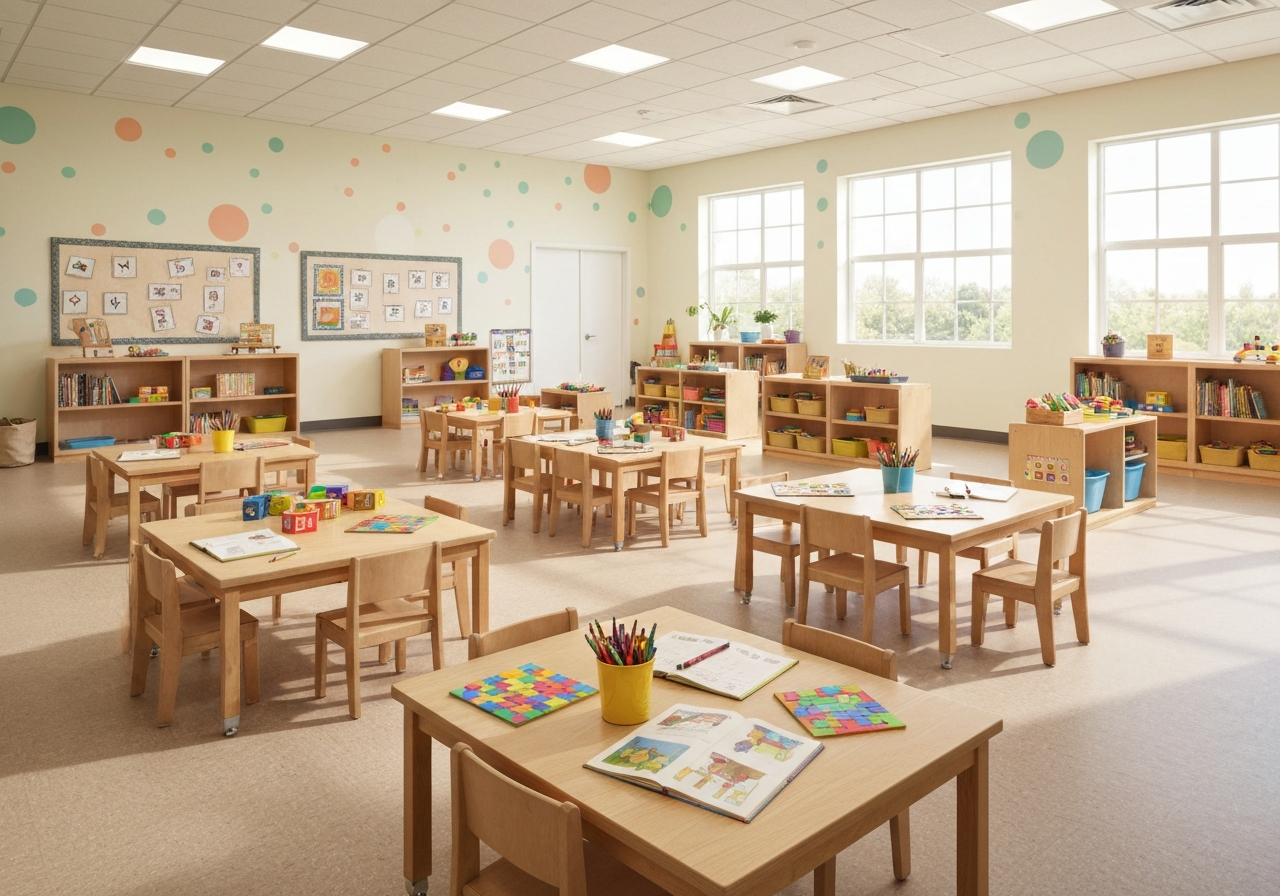
A structured preschool day builds the same developmental domains researchers point to, social play with peers, following classroom routines, early literacy exposure, fine motor practice, but does it consistently, every day, with staff trained specifically in early-childhood development. That consistency is hard to replicate at home alone, especially for working parents juggling everything else on a weekday.
At Strong Roots Preschool in Northridge, our daily program is built around exactly these domains: social-emotional growth, language and early literacy, fine motor skills, and the kind of independence that makes the first day of kindergarten feel familiar instead of overwhelming. If you're weighing your child's kindergarten readiness age and want a program built specifically around closing that gap, schedule a tour of our Northridge classrooms to see how a typical day runs.
The bottom line on kindergarten readiness age
There's no single number that answers the kindergarten readiness age question for every family. California's cutoff, turning 5 by September 1, tells you when your child is eligible. It doesn't tell you whether they're ready, and it doesn't need to be the only factor in your decision, especially if TK is an option for a 4-year-old who isn't quite there yet.
What actually matters, according to every source above, is the whole child: how they manage their emotions, how they play with others, how they communicate, and how curious they are about the world in front of them. Those are things you can build well before the first day of school, through ordinary routines at home and through time spent in a preschool classroom built around exactly these skills.
If you're in Northridge or the San Fernando Valley and want to see what a readiness-focused preschool day actually looks like, reach out to Strong Roots Preschool to schedule a visit. We can walk you through where your child stands today and what a program built around these five domains looks like between now and their first day of kindergarten.
