










What Should a High-Quality Infant Program Look Like? A Complete Guide for Northridge Families
If you're touring daycares in Northridge with a six-month-old strapped to your chest, you've probably already asked the obvious question: what should a high-quality infant program actually look like, and how do you tell it apart from a place that's just watching babies until pickup? The short answer: trained caregivers, a real ratio you can verify, a curriculum built around how infant brains actually develop, and a level of communication that makes you feel like a partner instead of a customer. Everything else in this guide breaks that down into things you can actually check on a tour.
Why Does Infant Care Quality Matter So Much in the First Year?
The first year of life builds more brain architecture than any other stretch of childhood. According to Zero to Three, a baby's brain is about a quarter the size of an adult's at birth and roughly doubles in size within the first year, producing more than a million new neural connections every second during early childhood. That pace doesn't happen just because time passes. It happens in response to what a baby sees, hears, and feels every day, including in the hours spent in someone else's care.
How Does Quality Care Affect Brain Development?
The mechanism researchers point to most often is something Zero to Three calls serve and return. It's the back-and-forth between a baby and a caregiver: the baby babbles, the caregiver responds with eye contact and words, the baby tries again. Zero to Three's research describes this exchange as the interaction that actually builds cognitive skills like language, attention, and memory. A caregiver glued to a phone in the corner of the room isn't providing that kind of interaction, no matter how clean the room looks.
What Are the Long-Term Benefits of a Strong Start?
Long-term, the case for quality over convenience rests on the same idea: infant programs built on developmentally appropriate practice, the framework NAEYC accreditation is grounded in, aim to match daily activities to what a child's brain and body are actually ready for at each stage, rather than a one-size schedule. That grounding is also why the gap between a good program and a mediocre one usually isn't about toys or decor. It comes down to whether the adults in the room understand child development well enough to respond to it in the moment.
The American Academy of Pediatrics reinforces this from the medical side, encouraging caregivers to build safe, secure, and nurturing relationships with infants, with guidance on emotional and relational development starting as early as a baby's first newborn visit.
None of this shows up in a brochure, which is part of the problem. A center can have beautiful murals and still run on autopilot, and a plain room with worn rugs can be quietly excellent because of what the adults in it actually do all day. That's why this guide leans so heavily on things you can verify rather than things a center tells you about itself.
What Are the Key Characteristics of a High-Quality Infant Program?
When people ask what separates a high-quality infant program from a place that just meets code, it comes down to three things you can actually verify on a tour: who's caring for your baby, how many babies each caregiver answers for, and what the physical space is set up to do. Here's what each one should look like in practice.
Are the Caregivers Trained and Qualified?
California's Title 22 regulations don't just set ratios. They also spell out qualification requirements for infant center staff, with specific provisions covering the roles of Infant Care Center Director, Teacher, and Aide, according to the California Department of Social Services. On a tour, it's fair to ask what certifications the infant teachers hold, how long they've worked with infants specifically, and how often the center loses staff. High turnover in an infant room isn't just an inconvenience. It breaks the relationships that serve-and-return interaction depends on.
What Is the Infant-to-Caregiver Ratio Required in California?
This is the number every parent touring a California center should know before walking in the door. Under Title 22 of the California Code of Regulations, enforced by the California Department of Social Services' Community Care Licensing Division, licensed child care centers must maintain a minimum staff-to-infant ratio of one caregiver for every four infants. That ratio tightens even further off-site: when infants leave the center for any reason, such as a walk or an outing, California requires at least one adult for every two infants. During nap time, the rules require a staff member to visually observe sleeping infants, with no more than twelve sleeping infants per one observing staff member, while the facility-wide base ratio still has to hold.
It helps to know that this 1:4 figure is a legal floor, not necessarily a target. NAEYC's voluntary accreditation standards generally call for smaller group sizes and lower ratios than most states require by law, treating California's minimum as a starting point rather than a ceiling. A program running at exactly 1:4 all day, one teacher managing four infants at once, is meeting the law. A program built around getting below that number whenever possible is aiming at something else.
If you're touring infant rooms anywhere in the San Fernando Valley, ask to see the current ratio in writing before you commit to anything. At Strong Roots Preschool's Northridge infant program, we keep ratios at or better than the state minimum, and we'll happily show you the room before you schedule a tour.
What Do NAEYC's Program Standards Actually Cover?
NAEYC, the National Association for the Education of Young Children, is the largest accreditation body for early childhood programs in the country, and its ten program standards give a fuller picture of what quality means beyond ratios alone. They cover relationships between staff and children, curriculum, teaching, assessment of child progress, health practices, staff qualifications, family partnerships, community relationships, the physical environment, and leadership and management. Accreditation is voluntary and separate from California's Title 22 licensing, which is the mandatory floor every center has to meet regardless of whether it pursues NAEYC status. A program doesn't need a plaque on the wall to take these standards seriously, but a program that references them by name on a tour is usually one that has actually read them.
Is the Environment Safe and Stimulating?
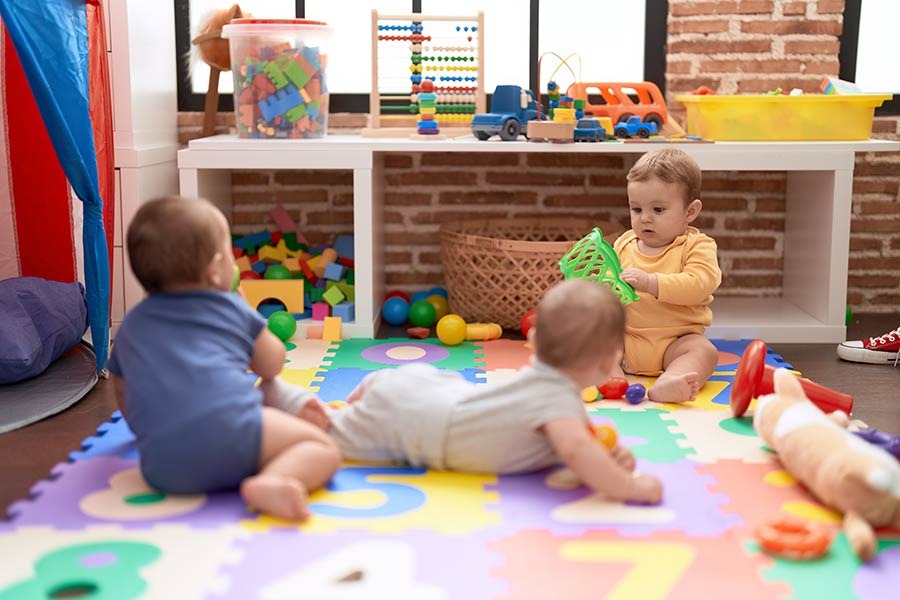
California licensing also sets physical space minimums. Licensed centers generally must provide at least 35 square feet of indoor space and 75 square feet of outdoor space per child, based on the center's licensed capacity, according to CDSS regulations. Beyond the square footage, what you're really looking for is a room set up for babies who are learning to move: open floor space for tummy time and crawling, low shelves with a few well-chosen toys instead of a towering pile, cribs that are empty and firm for safe sleep, and enough outdoor access for infants to get outside regularly. A stimulating room doesn't need to look busy. It needs to give a baby room to explore and adults room to actually watch them do it.
What Does a Real Infant Curriculum Look Like Compared to Just Babysitting?
One of the fastest ways to tell a high-quality infant program apart from basic supervision is to ask what caregivers are actually doing with your baby's day, not just whether your baby is fed, clean, and safe.
How Do Programs Support Physical, Social, and Emotional Growth?
NAEYC's infant program criteria describe what this looks like in specific terms: an environment that lets babies move freely and practice motor skills on their own initiative, varied literacy exposure through songs, rhymes, books, and one-on-one interactive play, and daily chances for fine-motor development through hands-on exploration. None of that requires expensive equipment. It requires caregivers who know what a six-month-old is working on developmentally and structure the day around it instead of just naps and bottles.
The social-emotional piece comes back to serve and return again. Zero to Three describes this responsive back-and-forth, a baby reaching for a toy and a caregiver naming it, a baby babbling and a caregiver babbling back, as the interaction that strengthens neural connections tied to language and attention. A curriculum that includes that kind of individualized response looks very different from a room where one adult manages four cribs and a feeding schedule with no time left for anything else.
What Role Does Play-Based Learning Play?
For infants, play-based learning doesn't look like structured lessons. It looks like sensory bins, textured toys, tummy time on different surfaces, and caregivers narrating what's happening as it happens. The goal isn't early academics. It's giving a baby's brain the varied input that Zero to Three's research points to as the driver behind those million-plus neural connections forming every second in early childhood.
What Safety and Cleanliness Standards Should Parents Expect in California?
What Do California's Title 22 Regulations Actually Require?
Title 22 of the California Code of Regulations is the primary rulebook for licensed child care centers in the state, enforced by CDSS's Community Care Licensing Division alongside the California Health and Safety Code. It covers staff qualifications, teacher-to-child ratios, building safety, and space-per-child requirements, including specific provisions for infant center staff roles. Licensing is the floor every center in California has to clear. It's worth remembering that licensing and accreditation aren't the same thing. Title 22 sets the legal minimum; something like NAEYC accreditation is a voluntary standard a program chooses to pursue on top of it.
What Does a Clean, Well-Designed Infant Space Look Like Day to Day?
Day to day, the details are less dramatic than a formal inspection and more about routine. Toys and surfaces get sanitized on a regular schedule, not just when something looks dirty. Shoes typically stay off in infant rooms. Diapering happens on a dedicated changing surface with a consistent handwashing routine before and after. Entry to the building is secured, so no one wanders in off the street to a room full of babies. None of this is glamorous. It's also exactly the kind of thing that's easy to verify simply by watching a room for twenty minutes during a tour.
How Important Is Parent Communication in Infant Care?
What Should Daily Communication Look Like?
The baseline is a daily report covering feeding times and amounts, naps, diaper changes, and mood, so you're not guessing about your own baby's day. Beyond the baseline, look for centers that send photos or short updates during the day and caregivers who greet you at pickup with something more specific than "good day." A caregiver who mentions that your baby rolled over for the first time, or was fussy after a shorter nap than usual, is paying attention in the way you'd want them to.
How Can Parents Build Strong Relationships with Caregivers?
Relationships go both directions. Share what's happening at home, a rough night, a new tooth coming in, a change in appetite, so caregivers can adjust rather than guess. Ask questions when something doesn't sit right instead of letting it build up. And when you find a caregiver your baby clearly responds to, say so. Staff retention in infant rooms is partly about pay and partly about feeling like the relationships they're building with your family actually matter to someone.
Is Daycare Bad for Infant Attachment?
This question comes up in nearly every parenting forum, and it deserves a straight answer instead of reassurance by slogan. The most substantial evidence here comes from the NICHD Study of Early Child Care, which followed 1,153 infants across 10 research sites from age 1 month to 15 months. The finding: child care experience itself, including quality, amount of time, the age a baby started, how stable the arrangement was, and the type of care, did not have a significant main effect on infant-mother attachment security on its own. What did predict attachment security was maternal sensitivity and responsiveness, meaning a parent's own attentiveness to their baby's cues mattered more than whether the baby was in child care at all.
There's an important caveat. The same research found infants were less likely to be securely attached specifically when low maternal sensitivity combined with poor-quality child care, more than minimal hours in care, or more than one care arrangement. In plain terms: quality of care doesn't create attachment problems by itself, but it can add to existing risk factors when several line up at once. That's exactly why the ratio, staffing, and curriculum questions in this guide matter. They're not the whole story of attachment, but they're the part a program actually controls.
When Can Babies Start Daycare?
There's no single mandated age at which babies are ready for daycare. Pediatric guidance generally emphasizes prioritizing the quality of the setting over hitting a specific calendar date. Some pediatric guidance suggests that in the earliest months, infants benefit most from consistent one-on-one interaction, tied to early attachment formation and to immunity that's still developing at that age. Because that guidance isn't built around one fixed mandate, treat it as a general framework rather than a countdown clock. Talk with your pediatrician about your own baby's needs, and if you do start earlier, weigh the ratio and caregiver-consistency questions above even more heavily.
How Do You Choose the Right Infant Program for Your Family?
What Should You Consider Before Deciding?
Start with the practical filters: commute and hours that actually match your work schedule, a waitlist timeline that lines up with when you need care, and a cost range you can sustain long term, not just for the first month. Then layer in fit: an infant program's philosophy on things like screen time, outdoor play, and discipline should match how you're raising your baby at home, or at least not clash with it. If a program can't clearly explain its approach to any of these, that's information too.
Infant spots fill up faster than spots for older toddlers, partly because there are fewer of them due to the tighter ratio requirements. If you know you'll need care, it's worth starting the search and getting on waitlists earlier than feels necessary, even before your baby is born. A program with a long waitlist is often a good sign; it usually means families who already have a child enrolled are trying to get a sibling in too.
What Should You Look for When Touring an Infant Room?
Ask directly about the current ratio in that specific room right now, not the licensed maximum. Ask how long the infant teachers have been there and whether the same caregivers work with the same babies consistently, since that consistency is part of what serve-and-return interaction depends on. Watch for safe sleep practices in the cribs, visible sanitizing routines between activities, and whether staff are actually talking, singing, and making eye contact with babies rather than just moving through tasks. A program that's confident in its answers will let you see all of this without hesitation.
What Does Infant Care Cost, and Are There Resources to Help?
Cost is one of the biggest factors in any child care decision, and it varies widely depending on location, hours, and program type, enough that we won't quote a flat number here without solid local data behind it. What's worth knowing is that federal programs exist to help. The Child Care and Development Fund and Early Head Start are both federal programs aimed at helping families access child care and early learning support, and a Dependent Care FSA is a federal tax-advantaged benefit some employers offer that can offset child care costs. None of these are California-specific programs, but California families can access them as part of the national safety net, and they're worth asking your HR department or a local resource and referral agency about before ruling out a program on price alone.
How Does Strong Roots Preschool Put This Into Practice in Northridge?
Strong Roots Preschool's infant program in Northridge starts from the same research covered in this guide: Title 22's 1:4 ratio as the legal floor, Zero to Three's serve-and-return framework as the daily practice, and NICHD's finding that caregiver sensitivity is what actually protects attachment. The goal isn't just clearing the state minimum. Caregivers here work at knowing each baby's cues well enough to respond consistently, since that consistency is what the research keeps circling back to.
Families in Northridge and the surrounding San Fernando Valley are welcome to see this in person before making any decision. A tour of our infant classroom shows the ratio in the room that day, not just a number on paper, and gives you time to watch how our teachers actually interact with the babies already in their care. Bring your questions about ratios, staff turnover, and daily routines. We'd rather answer them in person than have you guess.
If your family is planning further ahead, it's worth knowing that the same emphasis on ratios, trained staff, and responsive caregiving carries through as children move from Strong Roots' infant room into our toddler and preschool classrooms, so the transition doesn't mean starting over with a new philosophy.