






What Does STEM Learning for Toddlers Really Look Like?
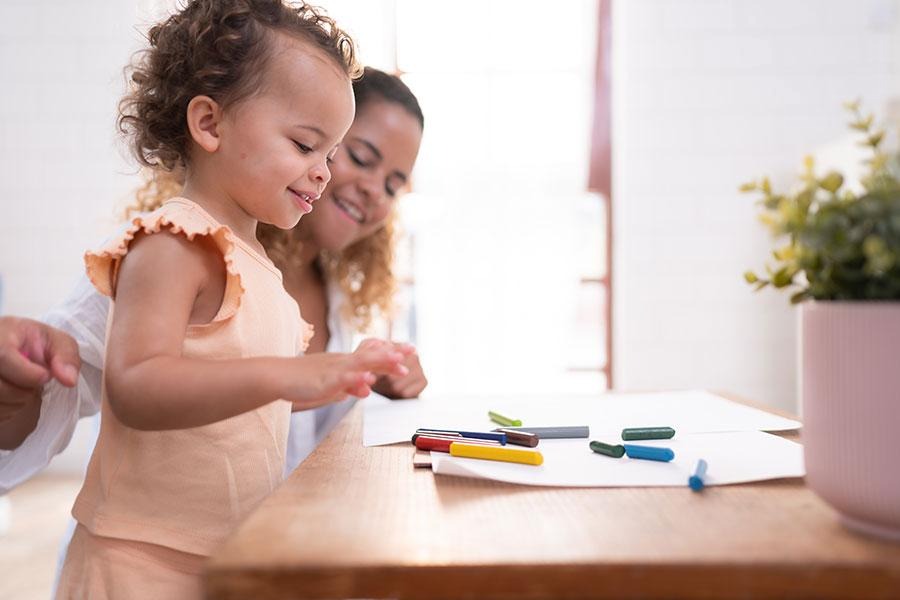
STEM learning for toddlers doesn't look like a worksheet or a science kit with a manual. It looks like a two-year-old stacking blocks until they topple, a toddler noticing that the plastic cup floats but the metal spoon sinks, or a child lining up cars by size without anyone telling them that's "math." If you've wondered whether your toddler is too young for STEM, or whether a preschool's STEM claims are more marketing than substance, the short answer is: STEM starts earlier than most parents expect, and it rarely looks like a lesson.
At Strong Roots Preschool in Northridge, this is the whole point. STEM isn't bolted onto the day as a special activity block. It shows up in the sandbox, the block corner, and the snack table.
What Is STEM Learning for Toddlers, Really?
STEM stands for Science, Technology, Engineering, and Math, and for toddlers, it means exploring those four areas through play rather than instruction. There's no lecture, no worksheet, and no test. A toddler doing "science" might just be squeezing a sponge in a water table and watching what happens. A toddler doing "engineering" might be figuring out why a tower of six blocks keeps falling over.
The research group ZERO TO THREE puts it plainly: babies are natural scientists, using their senses from birth to form hypotheses, test predictions, and figure out how people and objects relate to each other. That's not a metaphor. It's how infants and toddlers actually learn to navigate the world, and it's already happening long before anyone calls it "STEM."
A growing body of early childhood research backs this up. According to ZERO TO THREE's work on STEM and toddlers, the early childhood field increasingly recognizes the value of STEM activities for infants and toddlers, and building this foundation early helps children succeed later, both in school and beyond it. That's the case for treating a toddler's block tower or muddy puddle experiment as real learning, not just something to keep them busy. It's part of why more preschools are being asked to explain, specifically, what STEM learning for toddlers means in their own classrooms.
Is My Toddler Too Young for STEM?
No. If your toddler can stack, sort, pour, or ask "why," they're already doing STEM thinking. The idea that STEM has to wait until kindergarten, or even preschool, doesn't hold up against what early childhood researchers have found.
Early math skills in particular seem to matter more than most parents realize. Research summarized by ZERO TO THREE found that early math competency in young children forecasts later achievement not just in math, but in literacy as well. That's a surprising connection. Learning to compare "more" and "fewer" blocks at age two appears to be tied to how well a child reads years later.
There's also a fairness angle here that doesn't get talked about enough. The same research notes that income-based achievement gaps in math skills are already present by the time children start kindergarten, and that children pick up messages, including bias, about who "belongs" in STEM from the adults around them at a very young age. By early elementary school, kids have often already formed a positive or negative sense of themselves as capable in STEM subjects, shaped largely by how educators and caregivers responded to their questions and mistakes early on.
That's a strong argument for exposing toddlers to STEM concepts through play now, in a low-pressure way, rather than waiting until it feels more "official." A toddler who is praised for trying to figure out how a shape sorter works is quietly building a different relationship with math and science than one who's told to wait until they're older.
This is also why STEM learning for toddlers looks so different from what many parents picture when they hear the word "STEM." There's no test to pass and no benchmark to hit by a certain birthday. The goal at this age is exposure and encouragement, not mastery. A toddler who spends fifteen minutes moving water between cups is building the same underlying skills as an older child running a more structured experiment, just without the vocabulary to describe it yet.
One thing worth remembering: none of this requires flashcards or drills. As ZERO TO THREE researcher Rebecca Parlakian puts it, "Math instruction for young children is not a paper-and-pencil experience." For a toddler, math and science look like play, questions, and noticing things, not sitting still with a pencil.
What Are the Four Parts of STEM, and What Do They Look Like in a Toddler Classroom?
Each letter in STEM shows up differently depending on a child's age, but for toddlers, all four tend to blend into ordinary play rather than existing as separate subjects.
What Does "Science" Look Like for a 2-Year-Old?
For a toddler, science is mostly observation and cause-and-effect. It's noticing that ice melts, that the ball rolls farther on the smooth floor than the carpet, or that the plant needs water to perk back up. Simple sensory activities work well here: water play where a toddler pours between containers of different sizes, a basic homemade "volcano" using baking soda and vinegar, or a sensory bin with sand, rice, or water beads to explore texture and material.
None of this requires a lab coat or a kit. A toddler poking at melting ice on a hot afternoon is running an experiment, even if nobody calls it that.
What Counts as "Technology" for a Toddler?
Technology for toddlers doesn't mean screens, or at least not primarily. It includes any tool a child uses to solve a problem or make something happen: a shape sorter, a simple cause-and-effect toy that lights up or makes a sound when pressed, or even a spoon used as a tool to move water from one cup to another.
Some families do introduce simple coding toys at this age, like Botley or Cubetto, which let toddlers give basic directional commands to a small robot without any screen involved. These can be fun, but they're optional. A toddler doesn't need a robot to build early technology skills. Everyday tools do the job.
How Do Toddlers Practice "Engineering" Through Play?
Engineering, at the toddler level, is problem-solving with materials. Building a tower out of blocks and watching it fall is engineering. So is figuring out how to fit puzzle pieces together, stacking cups into a pyramid, or working out how to balance Magna-Tiles into a wall that doesn't collapse.
The value isn't in the finished structure. It's in the trial and error. A toddler who tries three different ways to stack blocks before finding one that works is practicing persistence and problem-solving, which are exactly the skills engineering is built on.
How Do Toddlers Build Early Math Skills?
Early math for toddlers is about noticing quantity, pattern, and comparison, not numbers on a page. Sorting toys by color or size, counting out loud while climbing stairs, comparing which cup has "more" water, or noticing that the tile pattern on the floor repeats are all early math experiences. These small moments are where STEM learning for toddlers really lives, long before any formal math lesson begins.
ZERO TO THREE's research suggests some of the most effective moments for building this happen during ordinary routines: using spatial words like over, under, and behind while walking together, or talking about "two more bites" during a meal. None of it needs to be formal, and none of it needs a curriculum.
What STEM Activities Can I Do With My Toddler at Home?
You don't need special materials to build STEM learning for toddlers into your child's day. According to ZERO TO THREE's guidance on toddlers and STEM, the most effective approach folds STEM into routines you're already doing, rather than adding formal lessons on top of an already busy day.
A few ways to do that:
Talk about the weather while getting dressed in the morning. Ask what the sky looks like, whether it feels cold or warm, and what that might mean for what to wear. This builds observational science skills without any extra setup.
Use spatial vocabulary during everyday movement. Words like over, under, behind, and next to, said out loud while walking or playing, build spatial reasoning that supports later math skills.
Point out patterns you already have at home. Floor tiles, striped shirts, and even the arrangement of items on a shelf all offer a chance to notice repetition, which is an early math concept.
Count and talk about volume while cooking together. Toddlers who are old enough to stand safely nearby can help count spoonfuls of flour or notice which measuring cup holds more.
Use simple math language during transitions. Saying "two more bites and then we're done" or "one more page and then bedtime" builds number sense in a context a toddler already understands.
These small moments add up. None of them require a shopping trip or a special toy, which matters for busy families trying to fit STEM into a day that's already full.
What's the Difference Between STEM and STEAM for Young Children?
STEM stands for Science, Technology, Engineering, and Math. STEAM adds an A for Arts, which covers visual art, music, movement, dance, and other forms of creative expression. In early childhood classrooms, the distinction matters less than it might sound.
Neither term means formal instruction at this age. According to early education sources including K12.com's comparison of the two approaches and The Gardner School's take on STEM versus STEAM in early education, STEM introduces basic scientific, mathematical, and engineering concepts through hands-on activities, while STEAM layers creative and artistic expression into that same exploration. A toddler painting with ice cubes dipped in colored water is doing STEAM. That same toddler noticing which color mixes turn brown is doing the STEM part of it.
For a toddler classroom, the two tend to overlap constantly. A block tower that gets decorated afterward, or a science experiment that ends in a drawing about what happened, blends both without anyone needing to draw a hard line between them.
This distinction matters if you're touring preschools and hearing the word "STEM" in every other sentence. Real STEM learning for toddlers doesn't need a special label on the door or a branded curriculum box. It shows up in ordinary materials used with intention: blocks, water, sand, and simple sorting toys, guided by teachers who know what to notice and how to build on it. If a school can't point to specific moments in the daily schedule where this happens, "STEM" is probably doing more work as a marketing word than as a description of what actually happens in the classroom.
How Much Screen Time Is Okay for STEM Apps at This Age?
For toddlers, less is generally better, and quality matters more than the app's label. Pediatric guidance summarized by sources including Nemours KidsHealth and CHOC's summary of updated AAP recommendations notes that for children 18 to 24 months, if parents do choose to introduce digital media, it should be high-quality programming, such as PBS or Sesame Workshop content, watched together with a caregiver who talks through what's happening on screen. Video-chatting with family members is generally treated differently from other screen time and isn't counted against these limits.
Older AAP guidance leaned on a rough cap of about an hour a day for this age group. The more current framework moves away from a strict hour count and instead asks parents to weigh five factors sometimes called the "5 Cs": the child, the content, whether the child stays calm, whether the screen is crowding out other important activities like sleep or play, and whether there's communication happening around the screen rather than passive viewing.
In practice, this means a labeled "STEM app" isn't automatically better than no screen at all. A toddler stacking real blocks or splashing in a water table is doing more hands-on STEM learning than most apps can offer. If a screen is used, sitting with your toddler and talking about what's happening on it matters more than the app itself. In short, screen-based options are a small piece of STEM learning for toddlers, not the main event.
What Are the Signs My Toddler Is Ready for More STEM Exploration?
Most toddlers show readiness signs earlier than parents expect. Sustained curiosity is one of the clearest: a toddler who keeps returning to the same toy or activity, trying different approaches, is showing the kind of engagement that supports STEM thinking.
Persistence is another sign. A toddler who tries again after a shape doesn't fit in the sorter, or after a block tower falls, rather than giving up immediately, is practicing the problem-solving that underlies engineering and science.
Early spatial and quantity language is a third marker. Words like "more," "big," "under," or "again" show a toddler is starting to notice and describe relationships between objects, which is an early building block for math.
These signs line up with what researchers who study infant and toddler STEAM programs have described as wonder, persistence, and problem-solving in young children engaged in hands-on exploration. If your toddler shows even one or two of these behaviors regularly, they're already engaging with STEM concepts, whether or not anyone's calling it that. Taken together, these are everyday signs that STEM learning for toddlers is already happening, whether or not a parent has ever used the term.
How Does Strong Roots Preschool Build STEM Into Everyday Play in Northridge?
At Strong Roots Preschool, located at 9054 Darby Ave in Northridge, STEM isn't treated as an add-on subject. It's built into the classroom day through play-based learning and Montessori-inspired methods, alongside STEAM principles, Armenian language immersion, chess, math, and arts activities.
A typical morning gives a clear picture of what this looks like in practice. Toddlers move between a water table, a shelf of sorting materials, and a block corner, with teachers nearby asking questions rather than directing the activity. That's what STEM learning for toddlers looks like when it's built into the daily schedule instead of saved for a special unit: ordinary materials, real questions, and enough time for a child to try something three or four different ways before moving on.
That means the same block corner, sensory bin, and sorting activities described throughout this article are part of daily classroom life at Strong Roots, not a special event scheduled once a week. Toddlers stack, sort, pour, and build alongside teachers who are trained to notice and support the thinking behind the play, rather than just supervising it.
Strong Roots serves children from infancy (6 weeks) through after-school age, including the toddler and young preschool age bands (roughly 12 months through 3 years) this article focuses on. The school is licensed by the California Department of Social Services (license #195700760) and maintains staff ratios of 1 adult to 3 infants and 1 adult to 4 toddlers, with educators holding Child Development Associate credentials or California equivalents.
If you're a Northridge or San Fernando Valley parent wondering whether a preschool's STEM claims hold up in practice, the best way to find out is to see a classroom in session. Contact Strong Roots Preschool to schedule a visit and watch how STEM learning for toddlers actually plays out during a normal day, blocks, water tables, and all.