








about Strong Roots Preschool

Math Activities

You've heard your two-year-old count to ten. You've also wondered if that's real understanding or just a memorized song. Here's how to tell the difference, and what to do about it before kindergarten forces the question.

Math Activities

The Question You're Actually Asking

You're not worried about flashcards. You're worried about the moment your child sits down in kindergarten and either has a foundation to build on or doesn't. "Math for toddlers" sounds like it could be marketing, and you're right to be skeptical of anything that smells like busywork dressed up as curriculum. So here's the plain version: number sense either gets built now, through hands and objects, or it gets bolted on later, through repetition and pressure, after your child has already decided math is confusing.

You can test this yourself. Ask your child which pile has more, five blocks or three blocks, without letting them recount. If they can't answer without touching every block again, they've memorized a sequence of words, not a concept. That's common, and it's fixable, but it's worth knowing which one you're dealing with before kindergarten does the finding out for you.

What you get from real math activities for preschoolers isn't a head start on arithmetic. It's a child who trusts numbers because they've already used them to solve real problems, dozens of times, with their own hands.
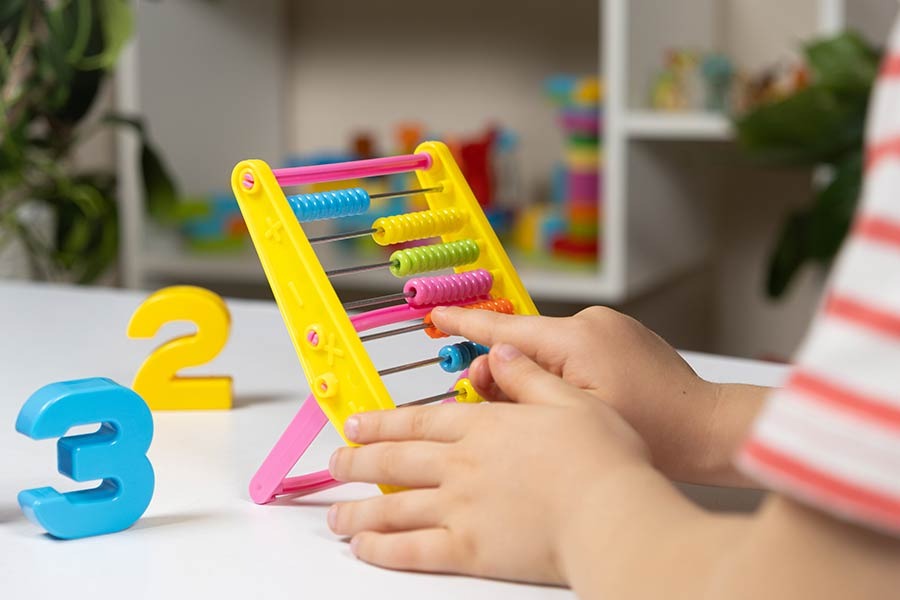
Math Activities

What Happens If This Gets Skipped

Here's what you're trying to avoid. Kids who move to written numbers and worksheets before they've had enough time sorting, stacking, and comparing real objects tend to guess instead of reason. They get an answer wrong, don't know why, and start associating math with a feeling of not being smart enough. That's the seed of math anxiety, and it starts a lot earlier than most parents assume.

You also lose something less obvious: problem-solving confidence. A child who's spent time figuring out how many more blocks a tower needs, or whether the red cup holds more water than the blue one, has practiced trial and error in a low-stakes way. Skip that stage, and the first time they hit a hard problem on paper, they have no instinct to fall back on except asking an adult for the answer.

Kindergarten readiness math isn't about knowing more numbers earlier. It's about whether your child has a working relationship with quantity, comparison, and pattern before anyone hands them a pencil.

Math Activities

What You Actually Get, Staged by Age

At Strong Roots Preschool in Northridge, math activities class meets weekly and is staged so your child is always working at the edge of what they're ready for, not behind it and not over their head.

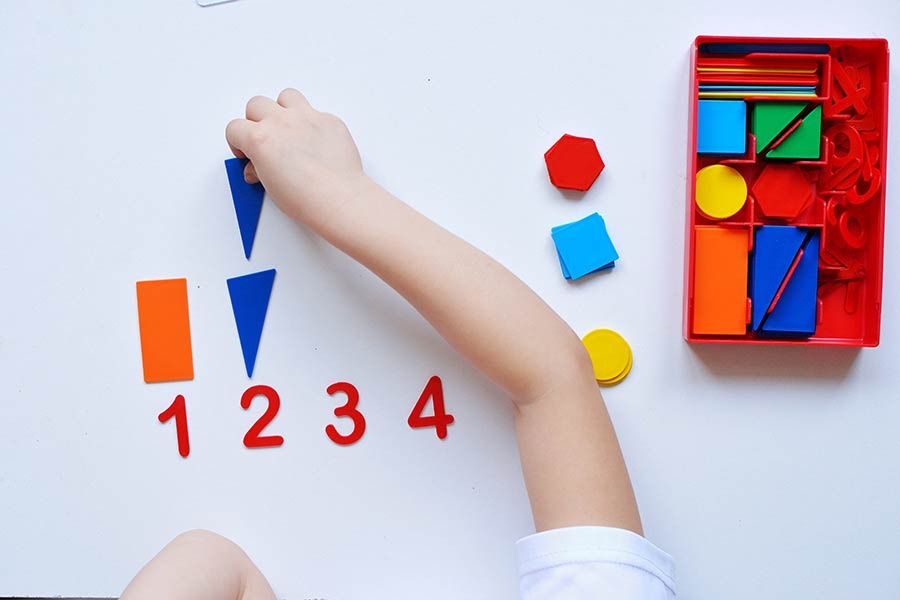
If your child is two to three, you get one-to-one counting practice, where they touch a single object for each number said, plus sorting by color, size, and shape, and early pattern recognition. If your child is three to four, you get number recognition to ten, counting sequences past twenty, first addition using real objects instead of abstract equations, measurement comparisons, and spatial reasoning through puzzles and building. If your child is heading into kindergarten at four to five, you get counting past thirty, addition and subtraction with manipulatives, an introduction to number lines, simple word problems solved out loud, and early time concepts like sequencing a day or reading a clock.

You also get this without your child sitting through a separate math period disconnected from everything else. The same skills show up during calendar time, while measuring ingredients for a cooking activity, and while building with blocks. Math is one of several weekly enrichment classes at Strong Roots, alongside Armenian language, arts, chess, Bible study, and physical development, and it's included in your enrollment, not billed as an add-on. Our program follows the California Preschool Learning Foundations for mathematical development, aligned with what CCRC-licensed preschools are expected to deliver.

Frequently Asked Questions

It's a dedicated weekly class, but math concepts appear throughout the school day in calendar time, cooking, building, and other activities. The class deepens what children are already encountering.

We differentiate within the class. Children who grasp a concept quickly get extended challenges. We don't hold faster learners to the group pace.

Minimally, and only with older children. The primary instruction method across all age groups is hands-on work with physical materials. Worksheets appear occasionally in Pre-K for number writing practice.

The curriculum is consistent with the California Preschool Learning Foundations published by the California Department of Education for children under 5.

Kindergarten teachers expect children to count reliably, recognize numerals, and have basic pattern recognition. Children who arrive with a solid number sense foundation move faster through the kindergarten curriculum.

What Sets Our Northridge Preschool Apart

Local, CCRC-approved, built around developmental results.

Image 1

Licensed & Local

Strong Roots runs independently, not a franchise chain following a corporate playbook. We hold a CCRC license through the California Department of Social Services, and DSS inspections show up unannounced, not on a schedule we control. That is the point of licensing: it keeps a real state agency checking our work, not just our own word.

Small-Group Focus

California caps ratios at 1:3 for infants and 1:4 for toddlers. We hold those limits as a floor, not a target to drift toward. Smaller rooms mean a teacher notices sooner: a child pulling back socially, a child ready to move ahead of the group, a child just having a rough week. That kind of attention doesn't happen in a room stretched past capacity.

Specialized Educators

Every teacher on staff holds a Child Development Associate credential or an equivalent California qualification. CPR and First Aid certification come before a teacher is ever alone with a group of children, not after, and not as a box checked later.

Foundational Growth

We track developmental milestones per child and send progress home through daily reports, so parents aren't guessing between conferences. If something looks behind for a child's age, we say so directly and talk it through with the family, rather than letting a kindergarten screening be the first place it surfaces.

Secure, Modern Spaces

Campus entry stays secured, and the outdoor play yard is gated and split by age group so toddlers and preschoolers aren't sharing equipment built for different bodies. Classrooms follow a documented cleaning schedule. The facility is subject to state inspection, and records are available to any parent who asks.

Healthy, Fresh Meals

Meals and snacks come included with enrollment, planned around the age groups we serve. We work with common dietary restrictions and food allergies as a matter of course. Families get the week's menu ahead of time, and any allergy gets documented at orientation, not discovered later.

Not sure where to start. Schedule 30 min. preschool tour

Hear From Our Happy Families

Top-Rated Licensed Child Care in Northridge, CA

Image 1

Child Care Programs

Programs That Grow with Your Child

Image 1

Strong Roots is the only Armenian immersion infant care program in Northridge, CA. The program accepts children 18 to 24 months old who are walking independently. Groups are small and spots fill by age group throughout the year.

Strong Roots Preschool offers licensed toddler care in Northridge, CA for children 2 to 3 years old. The program runs Monday through Friday with structured daily activities, a weekly Armenian language class, outdoor play, and three meals and snacks daily.

Strong Roots Preschool offers licensed Young Preschool Care in Northridge, CA for children 2.5 to 3.5 years old. The program bridges toddler and full preschool with structured daily activities, a weekly Armenian language class, outdoor play, and three meals and snacks.

Strong Roots Preschool offers licensed preschool care in Northridge, CA for children 3 to 4 years old. The program covers Armenian language, arts, math, chess, physical development, and Bible study, with three meals and outdoor play Monday through Friday.

Strong Roots Preschool offers licensed Pre-Kindergarten Care in Northridge, CA for children 4 to 5 years old. The program prepares children for elementary school through an academic-focused curriculum including Armenian language, chess, math, arts, and physical development with three meals daily.

Strong Roots Preschool offers CCRC-licensed after school care in Northridge, CA for children in kindergarten through 5th grade. The program runs from school dismissal through 5:00 p.m. Monday through Friday, with homework help, Armenian language class, structured activities, and an afternoon snack.

See the Strong Roots Difference in Person!

Most daycares in Northridge are just rooms full of toys. Schedule a tour to see our CCRC-licensed classrooms in action. Meet our dedicated teachers, explore our secure play areas, and see how we prepare your child for a lifetime of learning.

Book a Tour

Preschool Classes

Early Childhood Education

Image 1

Between work, errands, and everything else a week holds, sitting down to teach your toddler Armenian rarely happens, even when you mean to. Maybe your own Armenian isn't strong enough to teach with confidence. Strong Roots runs a weekly Armenian language class in Northridge built for exactly this situation: parents who want the connection passed down but can't be the ones doing the daily teaching.

You've probably picked up a folder of nearly identical drawings before and wondered what your child got out of making them. That question matters more than it seems. Here's what an art class for preschoolers in Northridge should be doing for your child, and how to tell if it actually is.

If you're not sure what this class involves, or whether it's the right fit for a family that isn't religious, here's the plain version: it's a short, once-a-week session where a simple story leads into a conversation about something like sharing or honesty. Nobody is asked to pray or affirm anything. It sits alongside Armenian, Arts, Math, Chess, and Physical Development as one of several enrichment classes on the weekly schedule, and it gets the same light, age-appropriate treatment as the rest.

You want more for your child than a busy day of activities. You want to see them sit still, think before they act, and bounce back when something doesn't go their way. That's what a real chess class at this age is actually for.

You've heard your two-year-old count to ten. You've also wondered if that's real understanding or just a memorized song. Here's how to tell the difference, and what to do about it before kindergarten forces the question.

You know the signs. The bouncing off walls before dinner. The meltdown that comes from a full day with nowhere to run. The worry that another hour of tablet time is replacing the climbing, jumping, and chasing your child's body is actually asking for. You don't need a lecture about screen time. You need somewhere your child can move, every day, in a way that actually tires them out and builds them up.