How does play support physical and mental development?
Watch a three-year-old climb the wrong way up a slide and it looks like simple fun. But the balance and the quick physical problem-solving involved are firing through the same brain systems that will later handle attention and focus. Physical and mental development through play happens in exactly that moment: for young children, movement and thinking develop together through the same channel, and the research behind it is more specific than most parenting advice lets on.
The rest of this piece lays out why certain kinds of movement build thinking skills better than others, what a play-based classroom actually looks like structurally, and where the evidence is strong versus where it's still catching up, then walks through how a Northridge classroom puts that research to work every day.
What is the connection between movement and cognitive development?
Motor skill and cognitive skill development share neural real estate: training one measurably affects the other. A 2022 review in Frontiers in Psychology concluded that long-term motor skill learning and training comes with improved cognitive benefits, largely because building physical skill proficiency and building cognitive skill draw on overlapping brain resources. Shi and Feng's analysis also found something more specific: not all movement is equal. Open motor skills, movement in an unpredictable, changing environment like a basketball game or a game of tag, tend to produce bigger cognitive gains than closed motor skills: movement in a fixed, predictable pattern like running laps in a straight line.
That distinction matters for anyone deciding what "active play" should actually look like. Weaving through a group of other kids playing chase, reading their movements, and adjusting speed and direction on the fly is cognitively richer than jogging the same distance alone on a track. The unpredictability is the point. It forces the brain to process, decide, and adjust in real time, which is a very different demand than repeating a movement the body has already memorized.
Longitudinal data backs up the general link. The UK Millennium Cohort Study followed roughly 3,200 children from 9 months old through age 11, and found that gross motor skills (big-muscle movement like running, climbing, and jumping) were positively associated with spatial working memory, holding even after the researchers controlled for children's general cognitive ability. Fine motor skills told a slightly different story: they predicted stronger outcomes in English and science specifically, though not in math. Executive function, across the board, predicted academic achievement in every subject the researchers measured. In other words, the physical skills a child builds in preschool aren't separate from the academic skills a teacher will ask for years later. They're an early, measurable piece of the same picture.
How does play help a child's brain develop?
Play helps a developing brain by combining several ingredients at once that, individually, each support brain development, and together do more than any one of them would alone. The Frontiers review proposes five specific mechanisms behind the movement-cognition link: exposure to unpredictable environmental stimuli, interaction with peers, coordinating multiple limbs at once, the sheer complexity of agility and coordination demands, and cardiorespiratory fitness, which supports blood and oxygen supply to the brain. A child chasing a ball across an uneven playground, dodging a friend, and changing direction mid-stride is running all five of those mechanisms simultaneously, without anyone designing it that way. It just happens to be what active, social, physical play naturally involves.
Zero to Three, a national research and advocacy organization focused on infants and toddlers, describes play as itself a child's primary mode of learning during these years. Different kinds of play, building, climbing, jumping, pretending, matching, engage different parts of a young brain, which is one reason a good play-based day includes many different kinds of play across a week. A block tower, a pretend tea party, and an obstacle course each do slightly different developmental work. (This framing draws on Zero to Three's published content, captured through indexed search results rather than a direct page fetch at the time of writing; exact wording should be reconfirmed before quoting it directly.)
Why do some kinds of movement build thinking skills better than others?
Because the brain has to work harder to process movement it can't fully predict. Closed skills, the repetitive, same-every-time kind of movement, ask the body to execute something it has already learned. Open skills, the reactive, changing kind, ask the brain to keep reading a shifting environment and adjust the body's response on the fly, which is a heavier cognitive load layered directly on top of the physical one. That's the core reason a game of tag, freeze dance, or an obstacle course that changes every few days tends to build more than repeating the same lap around the yard.
Repetitive movement still builds strength, coordination, and confidence, and young children need both kinds of practice. A classroom aiming to connect movement to thinking leans toward variety too: new games, changing rules, an obstacle course that looks a little different every few days.
What is play-based learning, really?
Play-based learning sits between two extremes: pure unstructured free time on one end, direct instruction dressed up with toys on the other. According to the National Association for the Education of Young Children's developmentally appropriate practice framework, effective early-childhood teaching moves along a continuum. On one end sits self-directed play: a child initiating and controlling the activity entirely on their own terms. On the other end sits more structured, teacher-directed activity. Good practice, per NAEYC, means moving deliberately across that continuum over the course of a day: a teacher reads what a specific child needs in a specific moment and adjusts which mode leads.
NAEYC frames play more broadly as an important vehicle for building self-regulation, along with language, cognition, and social competence. Through play, children develop physical competence, make sense of the world around them, learn to interact with other people, practice expressing and managing their own emotions, and build symbolic thinking and problem-solving ability, often all within a single ten-minute stretch of pretend play or block building. That's a wide list of outcomes for something that, from the outside, looks like a kid just playing.
What's the difference between free play, guided play, and instruction?
Free play is entirely child-led: the child picks the activity, sets the rules, and decides when it's over, with no outcome the adult is steering toward. Guided play keeps that child-led exploration intact but adds a light adult hand, a question, a suggestion, a nudge toward a specific concept, without taking control away from the child. Direct instruction sits at the far end, where an adult sets the goal and the structure and the child follows it. NAEYC's framework treats all three as legitimate tools with different jobs, and describes effective teaching as knowing when to use which one across a normal day.
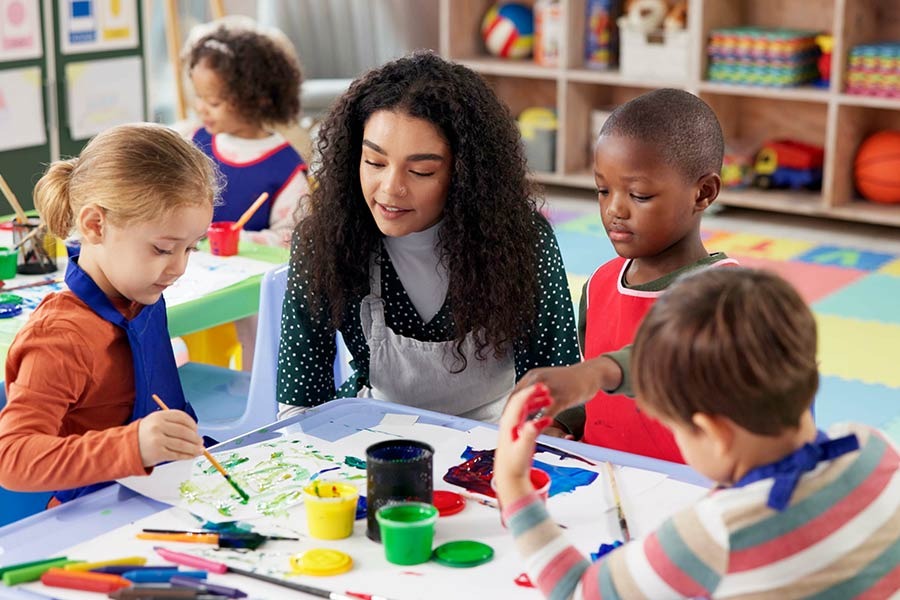
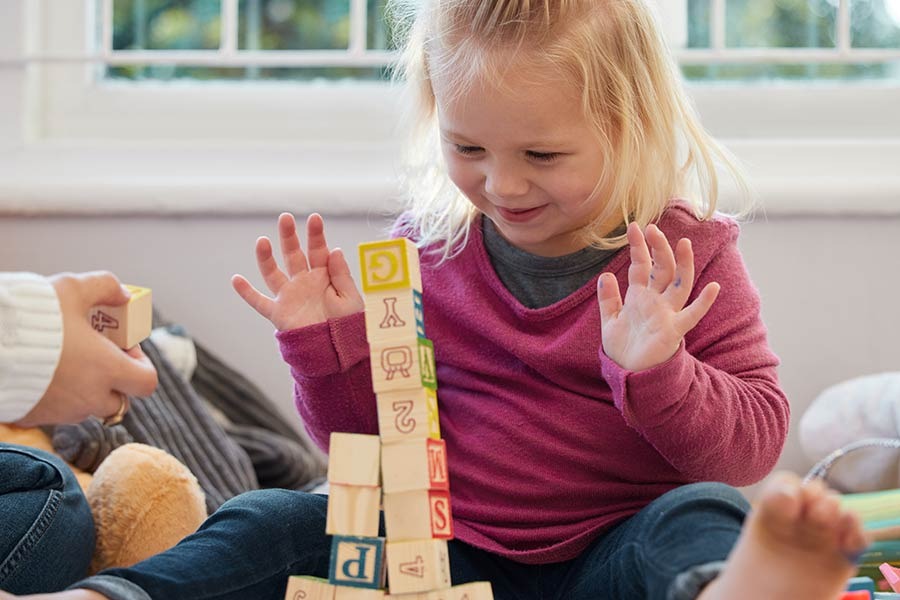
In practice, a teacher might let a child build with blocks entirely on their own terms for ten minutes (free play), then sit down and ask, "What do you think will happen if you stack this one on top?" (guided play), then later gather the group for a short, structured counting activity (instruction). Each of those three moments does different developmental work, and each one earns its place in a school day for a different reason.
Does physical activity actually improve executive function in kids?
The honest answer is: somewhat, and unevenly, with real limits on which thinking skills actually benefit. A systematic review covering 15 studies published between 2014 and 2021, focused specifically on preschool-age children, found strong evidence for a moderately strong association between motor competence (actual skill and proficiency in movement) and working memory. The same review found only a moderately weak association between motor competence and inhibition (stopping an already-triggered response), and inadequate evidence linking motor competence to cognitive flexibility, the skill of shifting between tasks or rules. The review's authors also drew an important distinction: physical activity alone, just moving the body without a skill or coordination demand attached, showed only weak associations with executive function measures generally.
This cuts against the simplest version of "exercise makes kids smarter." The research points to something more specific than treating physical activity as an undifferentiated block of time to check off. Motor competence itself, the skill of coordinating, balancing, timing, and adjusting movement, carries the stronger link to working memory. Running laps builds fitness. Navigating an obstacle course, judging distances, timing a jump, adjusting for a friend in the way, builds something closer to the specific cognitive skill the research measured. Movement paired with a real coordination or decision-making demand appears to carry more of the cognitive benefit than movement alone, though any movement still supports a child's fitness and confidence.
How does Strong Roots Preschool put this into practice in Northridge?
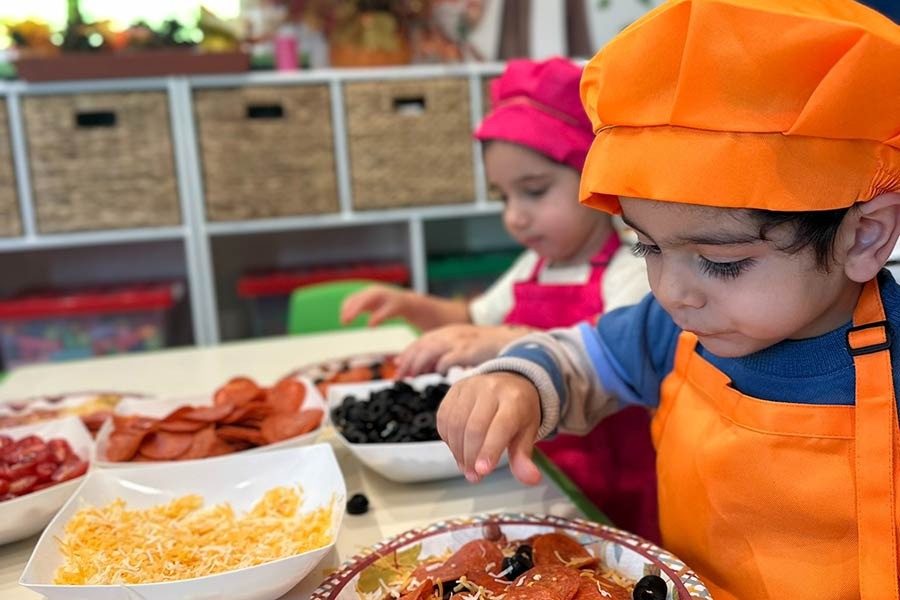
At Strong Roots Preschool in Northridge, California, this research shapes how a day is actually built, not just what's written in a brochure. The curriculum blends play-based learning with Montessori-inspired methods and STEAM principles, spanning Infant, Toddler, Young Preschool, Preschool, Pre-K, and After School programs, so the free-play-to-guided-play-to-instruction continuum looks a little different at each age but shows up at every stage.
For an infant, that might mean simple reaching and grasping games that build the earliest coordination. For a toddler or young preschooler, it looks like open-ended block play a teacher joins briefly with a question, then steps back out of. For an older preschooler heading toward Pre-K, it might mean a short, structured group activity layered on top of a morning that's still mostly free and guided play. Teachers move along that continuum throughout the day rather than treating any single mode as the whole curriculum, which lines up with what NAEYC's framework describes as effective practice.
Founder and Director Narine Mazmanyan brings a background in psychology and pedagogy, trained at the Pedagogical Institute of Armenia, with further study in medicine at Armenian State Medical College and additional coursework at LA ORT College and Marian College in the US. That training shows up in how the school pairs whole-child development with a second layer many programs skip: weekly Armenian language instruction, built into the regular week as heritage preservation rather than an academic add-on.
If you want to see how that continuum actually runs across a normal morning, schedule a tour of the Northridge campus and watch a classroom in session. Strong Roots is licensed by California Community Care Licensing under the California Department of Social Services, LIC #195700760, located at 9054 Darby Ave, Northridge, CA 91325. You can also explore the full program lineup from Infant through After School, or call (323) 990-8181 with questions about enrollment.
For a more detailed, domain-sorted list of specific activities you can try at home, our companion piece on fun activities to boost your child's growth and development walks through gross motor, fine motor, and cognitive play options by age. And if you're weighing the toddler years specifically, our piece on how our Northridge toddler program builds a foundation for life covers the attachment and brain-architecture research behind ages two to three.