
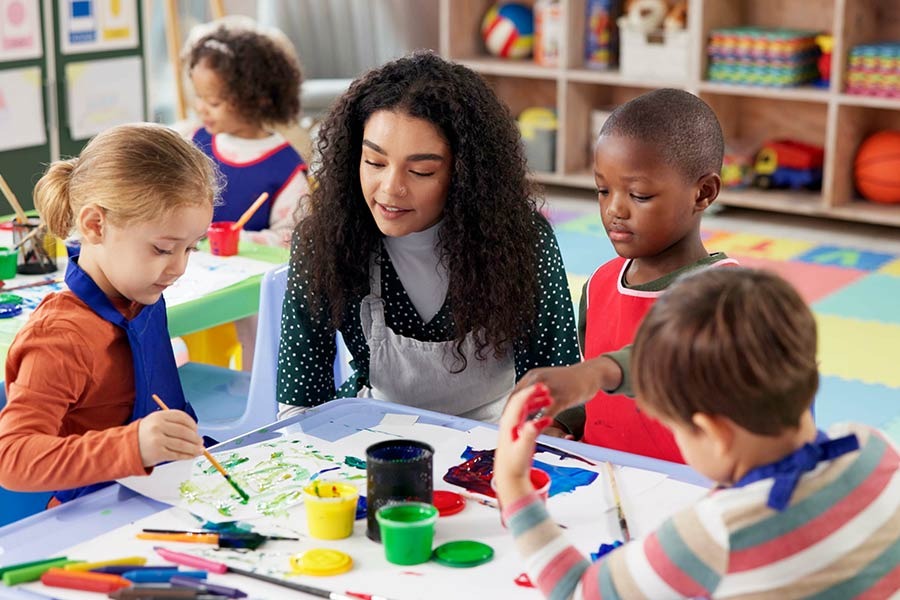
Arts and Crafts Program for Preschoolers in Northridge: Inside Strong Roots Preschool
If you're comparing an arts and crafts program for preschoolers in the Northridge area, the short answer is this: the best programs treat art as a weekly class with real developmental purpose, not a filler activity between naps and snack time. At Strong Roots Preschool, arts and crafts is one of the named enrichment classes children attend every week, taught by credentialed staff and built around a research-backed idea called process art.
This guide walks through why art matters for young children, what the difference between "process" and "product" art actually means, and what a week of arts and crafts looks like for a toddler versus a kindergartner at Strong Roots. If you're weighing a preschool arts and crafts program against a daycare that treats crafts as busywork, the distinction matters more than it might seem.
Why Is Art Important for Preschoolers' Development?
Art gives young children a low-pressure way to practice skills they'll use everywhere else: gripping a pencil, following through on an idea, sitting still long enough to finish something. It isn't decoration on top of "real" learning. It's part of how young kids build the physical and mental control that later schoolwork depends on. That's exactly why a well-built arts and crafts program for preschoolers deserves the same scrutiny parents give to reading or math instruction.
What Does Research Say About Art and Fine Motor Skills?
Every time a child squeezes a glue bottle, grips a paintbrush, or rolls a piece of clay, small muscles in the hand get a workout. The National Association for the Education of Young Children (NAEYC) notes that creative activities like gluing, drawing, painting, and working with clay or dough directly support small motor skill development in young children.
That matters for more than art class. The same hand strength and finger control a child builds cutting paper or rolling dough shows up again when they start forming letters. Crafts that involve cutting, gluing, and coloring build scissor control, hand-eye coordination, and finger strength, according to Early Learning Ideas, all of which lay groundwork for pre-writing skills. The Goddard School makes a similar point: craft and art projects strengthen the hand, wrist, and finger muscles kids need for writing, while also building patience and concentration along the way, per its guide to art activities for preschoolers.
Not all of it is fine work, either. Painting on a large surface, a mural on butcher paper taped to a wall, for instance, asks kids to reach, stretch, and use their whole arm and torso, which builds gross motor skills alongside the smaller-scale hand work, per a general roundup on arts and crafts benefits for preschoolers.
How Does Art Support Focus and Self-Regulation?
Art asks children to make a series of small decisions and stick with a task until it's done, which is exactly the kind of practice that builds focus. NAEYC points out that art supports self-regulation and self-control as children choose colors, decide where to place a shape, and work through a project to completion. That ability to focus is linked to later school success. Vocabulary grows too, especially when a teacher names new materials and tools as a child works with them ("Let's press the sponge instead of the brush this time").
What's the Difference Between Process Art and Product Art?
Process art is open-ended and child-led, with no fixed end product in mind. Product art (often called "craft") follows a set of steps toward an expected result, like a paper plate turned into the same lion face for every child in the room. Both have a place in early childhood, but preschool researchers increasingly favor process art as the more developmentally rich approach for young children. It's also why the strongest arts and crafts program for preschoolers leans toward process art without dropping craft-style projects entirely.
According to Kids by the Sea's breakdown of art versus craft in preschool education, craft activities involve distinct steps toward a required outcome, following a model the teacher provides. Art, in the process sense, has no planned outcome and puts the emphasis on the act of creating rather than the finished piece. Leaning only on product-directed crafts, the site notes, risks teaching children there's a single "right way" to make something, which runs counter to the kind of open exploration young kids need.
NAEYC goes further in its piece "What Will We Make? Using Process Art to Spark Preschoolers' Development", framing process art as a tool that grows expressive language, nurtures social-emotional development, and sharpens problem-solving and thinking skills. The organization treats process art as more developmentally supportive for young children than tightly product-directed activities.
Why Does Strong Roots Emphasize Process Art?
Strong Roots leans toward process art because it gives children room to make real choices instead of copying a template. A three-year-old smearing three colors of paint into a swirl isn't failing to make the "correct" picture. She's testing what happens when yellow meets blue, which is exactly the kind of open-ended thinking process art is meant to encourage. Craft-style, step-by-step projects still have a place at Strong Roots too. Cutting and pasting a specific shape builds different skills than free painting does. The point is balance, not banning one approach in favor of the other.
What Does the Arts and Crafts Program for Preschoolers Look Like at Strong Roots?
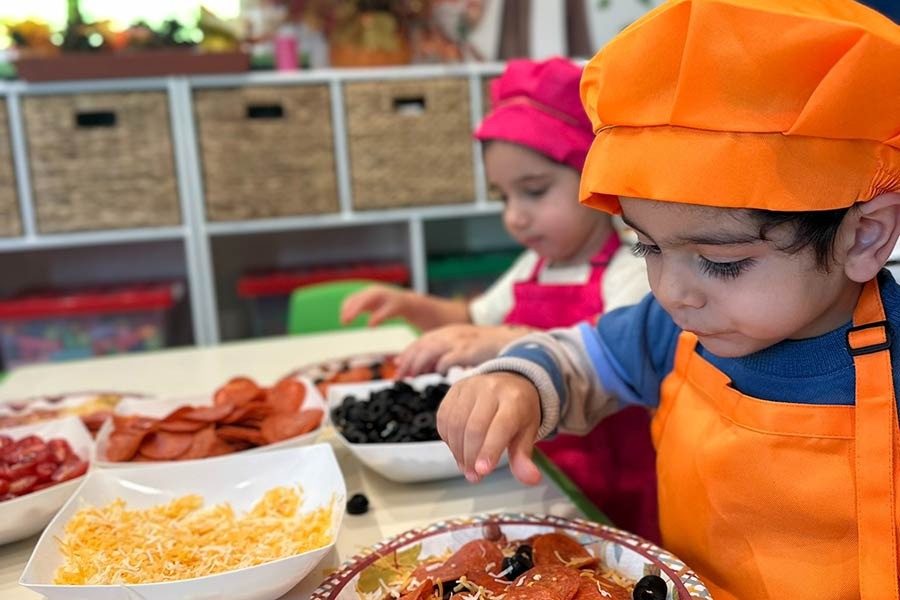
Arts and crafts at Strong Roots runs as a dedicated weekly class, not an optional extra bolted onto the schedule. It covers painting, drawing, sculpting, and crafting across the full range of ages the school serves, from toddlers just discovering finger paint to after-school kids capable of multi-step projects.
What Age Groups Does the Program Serve?
Strong Roots' programs span Infant Care (18 to 24 months) through the After School Program for kindergarten through fifth grade, with age-banded groups in between: Toddler (2 to 3 years), Young Preschool (2.5 to 3.5 years), Preschool (3 to 4 years), and Pre-Kindergarten (4 to 5 years). That range matters for how art gets taught. General early childhood guidance suggests toddlers around one to three years old engage with art mostly as sensory play, touching, smearing, and pressing with finger paints and simple materials. Preschoolers around three to four years move into more structured but still playful activities like gluing, cutting, and simple techniques. School-age children, five and up, can follow multi-step instructions and talk through their own ideas in more detail. Because Strong Roots' arts and crafts program for preschoolers spans this entire age range under one roof, a family enrolling a toddler today can expect the same program, adapted appropriately, to still be there when that child moves into after-school care years later.
What Materials and Mediums Do Children Work With?
Children work across painting and drawing, mixed media using paper, cloth, and natural materials, and sculpture or 3D projects with clay and recycled materials, along with collage work. That range matters because different materials ask different things of a child's hands and attention. Paint rewards big, loose motion. Clay rewards squeezing and shaping with more resistance. Collage rewards planning and placement. Rotating through mediums means kids aren't just getting good at one narrow skill, they're building a broader toolkit. This range is part of what makes a preschool arts and crafts program feel well-rounded instead of one-note.
Is Messy, Sensory Play Actually Good for Toddlers?
Yes. Messy, sensory play, squeezing, squishing, and molding different textures, helps build neural connections in young children, according to Lovevery's case for messy sensory play. It supports cause-and-effect understanding (squeeze harder, the paint spreads further), builds fine motor control, and lays groundwork for early math and science concepts, language development, and social-emotional skills.
For a parent watching a toddler smear finger paint across a table for the third time in a week, that's worth remembering. The mess isn't a sign the activity has gone off the rails. It's often the point. A toddler exploring a new texture with both hands is doing real developmental work, even if the end result is a paint-covered table rather than anything you'd hang on a wall. That's part of why a genuine arts and crafts program for preschoolers treats the mess as a sign things are working, not something to apologize for.
How Much Art Should Preschoolers Do Each Day?
There's no single universal number here, and any source claiming an exact daily minute count for every child should be treated skeptically. Early childhood education guidance generally favors keeping art materials open and available throughout the day, or building in a dedicated creative block, rather than chasing a rigid duration target. The emphasis stays on open-ended, child-led process art rather than clocking a set number of minutes. NAEYC's process art framework supports this same approach: consistency and availability matter more than a strict schedule.
In practice, that means a preschool arts and crafts program benefits more from having crayons, paper, or a sensory bin available most days than from a single, tightly timed 15-minute craft session squeezed between other activities.
Ready to see what a weekly arts and crafts class looks like in person? Schedule a tour of Strong Roots Preschool in Northridge and walk through an actual classroom during art time.
What Makes Strong Roots' Approach to Arts and Crafts Different?
Plenty of daycare websites mention an arts and crafts program for preschoolers and leave it at that, without saying much about how it's actually taught. At Strong Roots, arts and crafts sits inside a broader Montessori-inspired, STEAM-enriched curriculum, taught by staff who hold real credentials, at a licensed facility with staffing ratios that meet California's requirements as a floor, not a target to drift toward.
How Are Classes Taught by CDA-Credentialed Staff?
Every teacher at Strong Roots holds a Child Development Associate (CDA) credential or an equivalent California qualification, and CPR and First Aid certification is required before any teacher independently supervises a classroom. That's not a detail most daycare marketing pages mention, but it's the difference between an art activity led by someone trained in early childhood development and one led by whoever happens to be free that hour.
Strong Roots also maintains staff-to-child ratios at California's licensed minimums as a floor: 1 to 3 for infants and 1 to 4 for toddlers. During an arts and crafts class, that ratio is what allows a teacher to actually notice which child needs help holding scissors and which child is ready for a harder fold, instead of managing a room too large to give anyone individual attention.
How Does Art Fit Into a Montessori-Inspired, STEAM-Enriched Day?
Arts and crafts is one thread in a wider set of weekly enrichment classes at Strong Roots, alongside Armenian language instruction, chess, math activities, physical development, and age-appropriate Bible study. In a Montessori-inspired, STEAM-enriched setting, art isn't siloed off from the rest of the day. A sculpture project with recycled materials touches on basic engineering ideas (will this stand up?). A mixed-media collage with natural materials ties into science observation (what does bark feel like compared to a leaf?). Art becomes one more lens for the same STEAM thinking children are practicing in math and science activities elsewhere in the week.