









How Art Builds Confidence in Children
Your four-year-old holds up a painting and asks, "Is it good?" What you say next matters more than most parents realize. Research on praise language shows that how art builds confidence in children depends less on the finished picture and more on the specific words adults use to respond to it. Praise that focuses on effort and choices tends to hold up under later setbacks; praise that focuses on the child's identity or talent tends to be more fragile.
This isn't a small distinction. Two studies from psychologist Carol Dweck and her colleagues, run decades apart with different age groups, found the same basic pattern: kids praised for who they are (smart, talented, a natural artist) respond worse to failure than kids praised for what they did. Add in the fact that art gives young children a way to express feelings before they have the words for them, and a weekly art class starts to look less like a nice extra and more like real developmental work.
Below is what the research actually says, what it doesn't say, and what it looks like to put it into practice with a paintbrush in a three-year-old's hand.
Does Praising My Child's Art Actually Build Confidence, or Can It Backfire?
It depends entirely on the type of praise. Trait-based praise, telling a child they're smart or a great artist, can backfire once the child hits a setback. Process-based praise, focused on what the child did rather than who the child is, tends to hold up better.
That's the core finding from Melissa Kamins and Carol Dweck's 1999 study published in Developmental Psychology. The researchers ran two studies with children ages 5 to 6, giving them role-played success and failure scenarios. Kids who received praise or criticism aimed at their personal traits, "You're such a good boy," "You're so smart," showed more "helpless" responses afterward: worse self-assessments, more negative feelings, and less willingness to keep trying after a later failure. Kids who received praise or criticism framed around their process or strategy didn't show that same drop-off.
The researchers' conclusion was blunt. Trait-based feedback, even when it's glowing and positive, was tied to a more fragile, conditional sense of self-worth than feedback tied to process. A child who believes she's good because she's "talented" has more riding on the next drawing than a child who believes she's good because she worked hard and made deliberate choices.
What's the Difference Between Praising the Child and Praising the Process?
Praising the child sounds like "You're such a talented artist." Praising the process sounds like "You mixed those colors really carefully" or "You kept working on that even when it got tricky." The first ties the compliment to identity. The second ties it to something the child actually did, which the child can repeat on purpose next time.
That second point matters more than it first appears. A trait is fixed. Either you have it or you don't. A process is something a child controls and can choose to do again. When a parent praises the process, the child walks away with information: this specific thing I did worked, and I can do it again. When a parent praises the trait, the child walks away with an identity to protect, which gets a lot scarier the moment a drawing doesn't turn out the way she hoped.
What Should I Say Instead of "Good Job"?
Try describing exactly what you see instead of offering a generic verdict. NAEYC's guidance, "10X: 'Good Job' Alternatives," makes the case that a blanket "good job" doesn't tell a child what they did well or why it mattered, and recommends specific, descriptive language in its place.
The piece gives a concrete art example that's worth borrowing directly. Instead of "good job," a teacher responds to a child's drawing this way: "I see a blue sky, a yellow sun, and green grass around the big brown tree. This picture makes you happy, doesn't it?" Notice what's happening there. The adult is naming the actual choices the child made, the colors, the shapes, the arrangement, rather than handing out a stamp of approval that could apply to anything.
This takes maybe five extra seconds and doesn't require any special vocabulary. If your child hands you a painting, you don't need art-school language. You need to actually look at it and say what you see: "You used so much purple in the sky." "You made the dog bigger than the house, I love that." "You went back and added more clouds after you finished the first part." Every one of those tells the child something true and specific about their own choices, which "good job" never does.
Is Calling My Child "Talented" a Good Idea?
Probably not as a regular habit, based on how kids respond to ability-focused praise in the research. A 1998 study by Claudia Mueller and Carol Dweck, published in the Journal of Personality and Social Psychology, needs a caveat right away: it studied fifth graders, roughly ages 10 to 12, not preschoolers. The pattern is still useful for parents of younger kids to know about, but it hasn't been shown at preschool age specifically.
In that study, children completed a set of reasoning puzzles (Raven's Standard Progressive Matrices). After succeeding, some were told "you must be smart at these," others were told "you must have worked really hard," and a third group got no praise tied to a specific cause. The differences that followed were sizable. Children praised for intelligence sought out challenge-relevant information at far lower rates than effort-praised kids, 14% compared to 77%. They also misrepresented their own scores to peers more often afterward, 38% compared to 13% for the effort-praised group. When the group later faced a failure, the intelligence-praised kids showed less persistence, less enjoyment of the task, and worse performance than the effort-praised group. You can read the study details via PubMed.
The logic carries over reasonably well to art, even without a preschool-specific study to point to. "You're so talented" tells a child the good drawing came from something innate and unteachable. If the next drawing doesn't come easily, that leaves nowhere to go except concluding the talent ran out. "You worked really hard on getting that face just right" tells the child the good drawing came from effort they applied and can apply again.
How Does Art Help Children Express Feelings They Can't Say Out Loud?
Art gives young children a way to represent big feelings before they have the vocabulary to describe them. A three-year-old who can't yet explain why she's upset can still make an angry scribble or a sad picture, and that scribble does real emotional work.
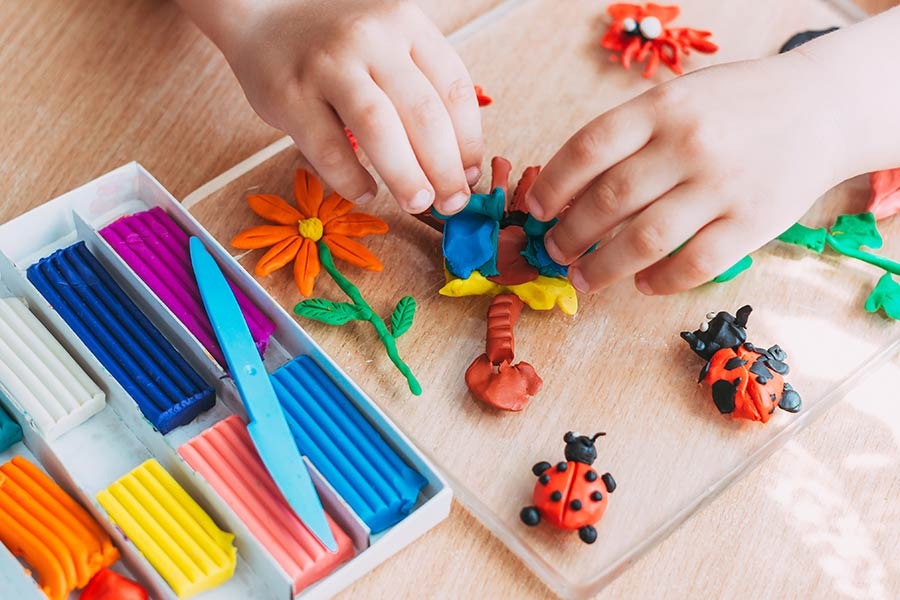
Zero to Three's guidance on social-emotional development for toddlers around ages 2 to 3 puts this directly: caregivers can suggest a child "draw a sad picture when they are down, or make angry shapes from play-dough when they are mad." The same resource notes that physical, creative outlets, including something as simple as ripping paper, give toddlers an acceptable place to put strong feelings when words aren't available yet. You can read the full guidance from Zero to Three.
This tracks with something a lot of parents notice without ever reading a study: a toddler who's had a rough morning will sometimes calm down mid-meltdown once you hand her a crayon and some paper. She is using color, pressure, and shape as a substitute for words she doesn't have yet, and that counts as a legitimate developmental function even though it also happens to buy five quiet minutes for the parent holding the crayon box.
Why Does Fear of Failure Show Up in Creative Kids, and What Helps?
Fear of failure in creative work tends to trace back to what a child was praised for in the past. If a child's sense of being "good at art" rests on being called talented, every new project puts that identity at risk. If a child's sense of being good at art rests on the fact that trying hard and experimenting usually pays off, a messy attempt simply becomes information to use next time.
That connects directly back to Kamins and Dweck's finding: trait-praised children showed worse self-assessments and more negative reactions after a failure task, while process-praised children held steady instead of spiraling. Believing "I'm talented" gives a child something to lose the moment a piece doesn't come out well, since talent either shows up or it doesn't. Believing "I try things and figure them out" skips that trap, because trying and figuring out is exactly what a rough draft or a messy attempt still counts as.
Zero to Three's guidance offers a related piece of the puzzle: "praise the process, not just the result," because it "helps children learn persistence and lets them know that trying hard is just as important as succeeding." A child who hears that consistently starts to internalize it. A wobbly painting counts as one attempt in a longer string of attempts, and the string is what matters.
This is the practical version of how art builds confidence in children: hundreds of small moments where trying counts more than the result.
How Does Strong Roots Build Confidence Into Its Weekly Art Class?
Arts and crafts at Strong Roots Preschool holds a dedicated weekly slot inside a Montessori-inspired, STEAM-enriched day. That structure gives children repeated, low-stakes chances to try, fail a little, and try again, which is exactly the pattern the research above says builds durable confidence rather than fragile confidence.
The weekly class sits alongside other enrichment classes at Strong Roots, including Armenian language instruction, chess, math, physical development, and age-appropriate Bible study. If you're curious how the arts and crafts program itself runs day to day, including the difference between process art and product-focused crafts, our companion piece on the arts and crafts program for preschoolers covers that ground in more depth. And if you want to understand the brain science behind why open-ended creative play matters at all, see our piece on creativity and brain development in children. This page keeps its focus on the confidence and emotional side of art; the mechanics and the neuroscience live in those two companion pieces.
How Are Classes Taught by CDA-Credentialed Staff?
Every teacher at Strong Roots holds a Child Development Associate (CDA) credential or an equivalent California-recognized qualification. That matters here more than it might seem: a teacher trained in early childhood development is more likely to notice when a child needs process-focused encouragement versus when a child needs space to work through frustration alone, and to respond with the kind of specific, descriptive language NAEYC recommends rather than a blanket "good job."
Staff-to-child ratios at Strong Roots are held at California's licensed minimums as a floor, 1 to 3 for infants and 1 to 4 for toddlers, which gives teachers the room to actually watch how a child responds to praise and adjust accordingly, instead of managing a room too full to notice. Strong Roots is a licensed California child care facility, license #195700760, located at 9054 Darby Ave, Northridge, CA 91325.
Curious what a class actually looks like? Schedule a tour of Strong Roots Preschool in Northridge and watch a session in person, or browse the full list of age-banded programs from Infant Care through the After School Program.
What Does This Look Like at Home?
At home, the same principles apply, just without a classroom around them. A few concrete habits, drawn directly from the research above, show how art builds confidence in children during ordinary weekday moments too.
Describe before you evaluate. When your child shows you a drawing, name what you actually see: the colors, the shapes, the choices, before you say anything that sounds like a verdict. NAEYC's example of "I see a blue sky, a yellow sun, and green grass" works because it names something specific and true.
Praise how your child got there, alongside what they made. Zero to Three's guidance to "praise the process, not just the result" applies just as well at the kitchen table as it does in a classroom. "You kept adding to that for a long time" lands differently than "wow, gorgeous," and it lands in a way that survives the next drawing that doesn't go as well.
Go easy on "talented" and "gifted." Based on how ability-focused praise played out with older kids in Mueller and Dweck's study, words like "talented" work fine as an occasional remark, but effort language should still carry most of the everyday load, since that's the part a child can actually control. "You figured out how to make the tree look 3D" still stands up after a future failure, in a way "you're a natural" simply doesn't.
Let art double as an emotional outlet. When your child is upset and the words won't come, Zero to Three's guidance to let a child draw a "sad picture" or make "angry shapes" from play-dough can be taken literally. Keep paper and crayons somewhere easy to reach for exactly this reason.
Paying attention to a child's actual choices, and saying so out loud, is the entire skill here. It doesn't call for an art degree, a Pinterest board, or a special set of supplies.
A Confidence Built on Trying, Not Just Talent
Every parent wants a confident kid, and it's tempting to build that confidence with big, warm compliments about how smart or talented a child is. The research on praise language says the opposite approach works better. Confidence that survives a bad day comes from praise tied to effort, process, and specific choices, the kind of praise that gives a child something repeatable rather than an identity to defend.
Art is a particularly good place to practice this because it produces so many small, visible moments to respond to: a color choice, a shape, a decision to keep going after a smudge. Every one of those is a chance to say something specific and true, instead of reaching for "good job" out of habit. Over time, a child who hears that kind of language learns that trying is the point. The finished piece taped to the refrigerator comes along as a side effect.
If you'd like to see how a weekly art class at Strong Roots Preschool puts this into practice, from toddlers experimenting with finger paint through After School Program kids working on more involved projects, reach out to schedule a tour of the Northridge campus.