








How does our Northridge toddler program build a foundation for life?
Somewhere between your child's second and third birthday, something bigger than potty training and picky eating is happening. Their brain is doing the heaviest wiring work it will ever do: building the circuits for attention, emotional control, language, and relationships that most of the rest of childhood gets built on top of. That's the real reason so many programs claim to build a foundation for life, and it's fair to ask whether the phrase means anything specific or is just a slogan. At Strong Roots Preschool's Toddler Care program in Northridge, CA, serving children ages 2 to 3, we think the research behind that phrase deserves a real explanation, not just a repeat of the marketing copy.
This isn't a guide to picking a program or getting through the tantrum years. It's the "why" underneath both of those questions: why the toddler years, specifically, do so much of the work in building a foundation for life, more than the years right before or right after. Four research threads back that up: brain architecture and "serve and return" interactions, executive function, attachment research that followed children all the way to age 18, and the economics of early investment. Here's what each one actually says, and how our Northridge classroom is built around it.
Why do the toddler years matter so much for long-term development?
Because the brain is laying its wiring during exactly this window, and the quality of a child's everyday interactions shapes how that wiring turns out. According to Harvard's Center on the Developing Child, brain architecture begins forming before birth and builds from simple neural connections into more complex circuits and skills that carry into adulthood. The first years of life are described as a critical period for establishing that foundation, with implications across cognitive, emotional, and social ability at the same time, not one skill developing in isolation.
"Toddlers learn a lot" undersells what's actually being claimed here. The toddler years are structurally different from later ones: a period when the architecture itself is still being built rather than simply added to. Get the wiring reasonably solid now, and later learning has something sturdy to attach to. Miss that window, and later intervention still works, just against a shakier structure instead of a stronger one. This is the actual mechanism behind a toddler program building a foundation for life, not a marketing phrase.
Put another way, the toddler classroom isn't a holding pattern before "real" school starts. It's the stage doing the most structural work, which is exactly why the research keeps pointing back to ordinary, moment-to-moment interactions rather than a specific lesson plan or workbook. A program that treats toddlerhood as filler time is skipping the part of a foundation for life that's hardest to rebuild later.
What is "serve and return," and why does it shape the brain?
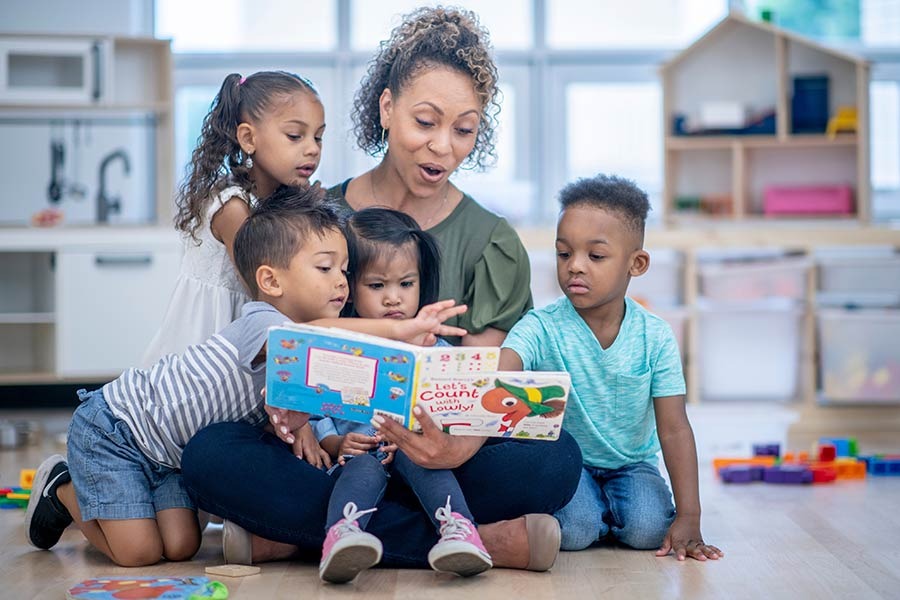
Serve and return is the back-and-forth exchange between a child and a caregiver: a baby babbles or points, an adult responds with eye contact, words, or a hug, and the loop repeats. Harvard's Center on the Developing Child describes these serve and return interactions as the mechanism that builds and strengthens neural connections, and Harvard's fast-facts summary is direct about the stakes: these responsive exchanges play an essential role in supporting healthy brain development and helping children learn to regulate emotions and form relationships.
Notice what that description doesn't require. Not a curriculum. Not flashcards. Not a special toy. It requires an adult who is actually present and responsive enough to catch the serve and return it, again and again, many times a day. That's a staffing question as much as a curriculum question, which is exactly why a low staff-to-child ratio matters more in a toddler room than it does almost anywhere else in a school.
Harvard's broader research on brain building through play adds the resilience piece: safe, stable, responsive relationships with caring adults can buffer children against sources of stress and support what the Center calls the foundations of lifelong health. Healthy brain architecture depends on a sturdy foundation, and that foundation gets built through stable, interactive relationships, not through any single activity or lesson plan.
What is executive function, and why does it start in toddlerhood?
Executive function is the set of mental skills that let a person hold information in mind, focus their thinking, filter out distractions, and switch between tasks. Harvard's Center on the Developing Child uses a memorable comparison: it works like an airport's air traffic control system, managing the arrivals and departures of dozens of planes across multiple runways at once. Executive function rests on three underlying abilities: working memory, mental flexibility, and self-control.
The part that matters most for a toddler classroom is this: children are not born with these skills. They're born with the potential to develop them, and that potential turns into an actual skill only through practice and interaction, starting in the earliest years. A toddler room that gives children real chances to hold a two-step instruction in mind, switch from one activity to another, or wait a beat before grabbing a toy is giving that air traffic control system its first real flight hours. Without that practice, the potential doesn't disappear, but it also doesn't get exercised, at exactly the age when it's most available to build. Executive function is arguably the clearest piece of "foundation for life" evidence there is: skills a toddler practices now become the skills a teenager relies on later.
Picture the ordinary version of this: a toddler mid-tantrum who's asked to wait a few seconds for a turn on the slide, or a child switching from cleanup time to snack time without a meltdown. Neither moment looks like a lesson. Both are executive function actually being exercised, in real time, in a room built to give a child enough chances to practice the pieces of a foundation for life.
Does secure attachment at age 2 really predict anything later?
Yes, a little, though the details matter more than a simple yes or no. The NICHD Study of Early Child Care and Youth Development, one of the largest and longest-running studies of its kind, found that child care quality alone did not clearly help or harm infant-mother attachment security measured at 15 months. Family characteristics, income and maternal education among them, turned out to be strong predictors of a child's outcomes regardless of what kind of care arrangement a family used.
But the study kept following the same children, and something showed up later that hadn't shown up at 15 months. Researchers found a small positive association between the observed quality of a child's early care, not the quantity of hours or the type of setting, and secure attachment "states of mind" measured at age 18 using the Adult Attachment Interview, a well-established clinical tool. In plain terms, the quality of the caregiving relationships a child experienced in their earliest years showed a measurable, if modest, link to how securely attached they appeared to be sixteen years later, as young adults. Reading Rockets' summary of the NICHD findings frames it the same way.
That word "modest" is worth sitting with rather than skipping past. This isn't a study claiming that a great toddler classroom guarantees a securely attached 18-year-old, and it doesn't erase the role that family income, parental education, and home life play, which the same research shows matter a great deal too. What it does say is that the quality of care a two-year-old receives isn't erased by time. It leaves a trace researchers could still detect sixteen years down the road, one small but real piece of the foundation for life that adult forms.
How does practicing independence now build skills for later?
By treating a toddler's clumsy attempt at a task as the actual lesson, not an obstacle to getting through the morning faster. HealthyChildren.org, the American Academy of Pediatrics' parent-facing resource, frames it this way: practicing self-help skills such as feeding and dressing builds large and small motor skills, confidence in trying new things, self-esteem, and pride in independence. Does watching an adult do it well teach a toddler anything? Not according to that framing. The skill comes from the child doing it themselves, slowly and imperfectly, until it isn't slow or imperfect anymore.
What self-help skills should a toddler be practicing?
The AAP's guidance points to concrete, ordinary moments rather than anything elaborate. Pulling on socks and pants. Working an arm into a sleeve. Laying clothes out the night before so the morning routine is simpler to manage. Offering a choice between two outfits, which sounds small but gives a toddler a real sense of control over their own day. Flashcards and worksheets look like curriculum. Pulling on socks or choosing between two outfits does not, but the AAP's own framing is that these ordinary tasks build motor skills, confidence, and independence together, three outcomes a worksheet can't reach.
A toddler classroom that hands a child their own shoes and waits, instead of doing it for them to save ninety seconds, is making a small trade every day: a little more time now, for a child who is more capable and more confident later. Multiply that trade by a full year in a toddler room, and it stops being small. It becomes part of the foundation for life this whole piece is describing.
Is investing in a quality toddler program actually worth it?
Yes, and the economics put a specific number on it. The Heckman Equation, built on research by Nobel laureate economist James Heckman of the University of Chicago, finds that every dollar spent on high-quality birth-to-five programs for disadvantaged children can deliver about a 13% return per year, driven by better education and health outcomes, employment gains for parents, and greater economic productivity over time. The number is documented, not estimated, and it's laid out in detail in Heckman's own ROI toolbox.
The timing matters as much as the number. What's known as the Heckman Curve shows that the highest rate of return comes from the earliest investments in a child's development, from birth through age five, and that starting at age three or four is already comparatively late. The underlying idea is that skills beget skills: early abilities in attention, language, and self-regulation make it easier to build the next layer of ability on top, in a way that compounds rather than simply adds up. A toddler program isn't competing with a strong kindergarten or a good elementary school. It's operating in the window where, according to this research, the same dollar and the same hour of attention builds more of a foundation for life than they would later on.
How does Strong Roots' Toddler Care program put this research into practice?
Every piece of research above points to the same operational question: does a classroom actually give a child enough responsive adult attention, enough practice at self-regulation, and enough room to try things independently? Our Northridge classroom answers that, piece by piece, turning "foundation for life" from a phrase into a daily habit.
Toddler Care serves children ages 2 to 3, staffed at a 1:4 staff-to-child ratio. We treat that ratio as a floor, not a target, meaning it's the minimum we'll operate at rather than a number we'd drift toward if a classroom got busy. That ratio exists for a practical reason tied directly to the serve-and-return research above: a teacher juggling too many children cannot physically notice and respond to every babble, gesture, and question in a day. A 1:4 ratio gives a teacher the room to actually catch those moments instead of just supervising them from across the room.
Every teacher in the classroom holds a Child Development Associate (CDA) credential or an equivalent California qualification, plus CPR and First Aid certification. The curriculum blends play-based learning with Montessori-inspired methods and STEAM principles; we're upfront that this is Montessori-inspired rather than a formally certified Montessori program, since that distinction matters if you're specifically shopping for accredited Montessori. Children get three meals and snacks daily, Monday through Friday, and weekly Armenian language instruction is built into the regular week rather than sold as an add-on, tied to the school's founding belief that a child's window for a primary language closes around age seven.
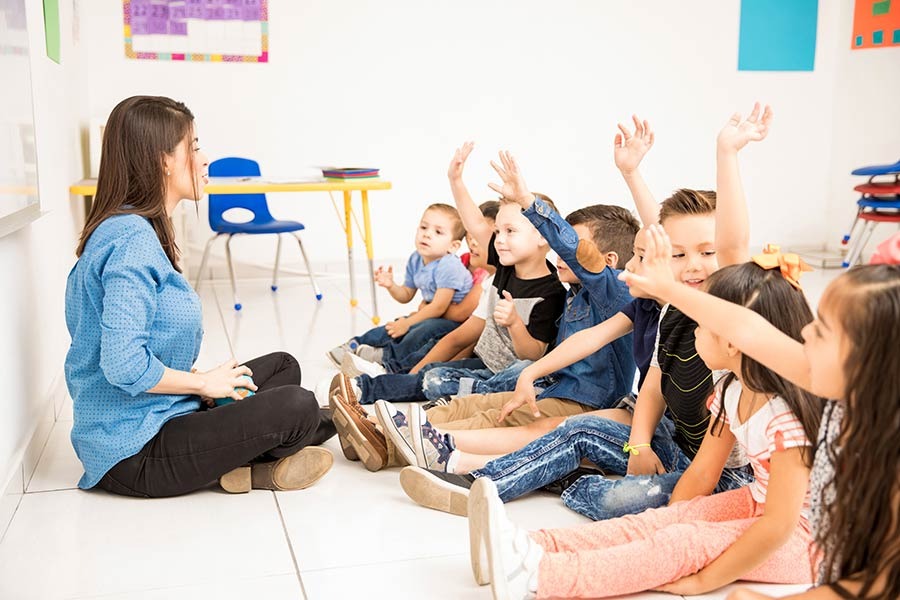
The independence piece shows up in ordinary moments across the day: a child pulling on their own shoes, choosing between two shirts, working through a puzzle a little longer before a teacher steps in. Stand in the doorway and watch, and nothing about it looks dramatic. That is exactly the point. The research above isn't describing a special program you buy; it's describing what happens inside consistent, responsive, everyday interactions repeated for a year or more.
Circle time, story time, and outdoor play fill out the rest of the day, and each one is really just another setting for the same serve-and-return pattern: a teacher noticing a child's question during story time and actually answering it, instead of moving straight to the next page. A brochure will never list that pause as a bullet point, yet it's where a foundation for life actually gets built, one ordinary exchange at a time.
Strong Roots is licensed as a CCRC facility under the California Department of Social Services, license #195700760, and operates at 9054 Darby Ave, Northridge, CA 91325, in the San Fernando Valley near CSUN. The school was founded in 2022 by Director Narine Mazmanyan, who trained in psychology and pedagogy at the Pedagogical Institute of Armenia, studied medicine at Armenian State Medical College, and completed further study at LA ORT College and Marian College in the US.
If your child is closer to two and a half and starting to outgrow a toddler-paced room, our Twaddler Transition guide walks through the Young Preschool Care classroom, ages 2.5 to 3.5, that bridges Toddler Care and full Preschool Care. And if you're still comparing toddler programs generally, ratios, credentials, and what to look for on a tour, our toddler program guide covers that ground directly.
How do I enroll my toddler at Strong Roots in Northridge?
The research explains why the toddler years matter. Seeing it in a real classroom is the only way to know if a specific program lives up to it. The best next step is to check current availability in the Toddler Care program and schedule a tour of the Darby Ave campus, where you can watch a teacher respond to a child in real time instead of reading about ratios on a page. Call (323) 990-8181 or email info@strongrootspreschool.com with any questions before you visit, and see the foundation for life we're describing built into an actual morning.