








Potty Training in a Weekend: A Realistic Guide for Northridge Parents
You bought the sticker chart. You cleared the calendar. You are ready to try potty training in a weekend and never buy diapers again. Here is the honest answer before you start: a weekend can absolutely kick off real progress, but the research behind the "3-day method" is thinner and older than most blog posts admit, and a normal timeline for full daytime training runs closer to three to six months of steady effort at home and at daycare.
That is not meant to talk you out of trying. It is meant to help you go in with the right expectations, so a rough Sunday afternoon feels like a normal part of the process instead of proof that something went wrong.
Is my child ready for potty training in a weekend?
Readiness matters more than the calendar date. A child who shows the signs below at 22 months will usually train faster and with less drama than a child who is pushed at 30 months without them, even though the older child is technically "old enough."
Pediatric guidance from the American Academy of Pediatrics points to signs appearing around 18 months for some children, with many families actually starting the process closer to age two, and most children staying dry during the day somewhere between 30 and 36 months. A clinical review from the American Academy of Family Physicians puts the developmentally-ready window at 18 to 30 months for most U.S. children, and notes that girls tend to show readiness a bit earlier, around 24 to 26 months, than boys, who more often show it around 29 months. Staying dry through naps arrives later still, at a median age of about 32.5 months for girls and 35 months for boys.
None of that is a deadline. It's a range, and it's your child's own cues right now, not their exact age, that tell you where things actually stand.
That guidance also answers a question a lot of parents don't say out loud: are we starting too early, or too late? The AAFP review found no harms from early training in healthy children without developmental delays, and it favors watching your child's own cues over hitting a specific age on a calendar. An 18-month-old hitting every readiness sign below doesn't need to wait for a "proper" age, and a 32-month-old who isn't showing them yet doesn't need to be rushed onto a schedule set by someone else's toddler.
What are the physical signs of readiness?
Look for a child who can walk steadily, pull pants up and down with some independence, and stay dry for stretches of an hour or two, which suggests the bladder is holding urine rather than releasing it constantly. Awareness of a full bladder or the urge to have a bowel movement, discomfort with a soiled diaper, and staying dry through a nap are all physical cues that the body is ready even if the child hasn't said a word about the potty. Pediatric guidance from Blueberry Pediatrics lists these alongside the ability to follow simple instructions, since a training weekend involves a lot of "let's go sit on the potty" requests that only work if your toddler actually understands them.
What are the emotional and cognitive signs?
Watch for interest, not just ability. A toddler who imitates a parent or older sibling in the bathroom, asks questions about the potty, or says they want to wear "big kid" underwear is telling you something real. Expressive language matters too. A child who can say "pee" or "potty" or even just point can participate in training in a way a nonverbal toddler can't yet. If your child actively resists sitting on the potty, cries at the suggestion, or shows zero curiosity despite repeated gentle exposure, that is useful information. It usually means giving it another few weeks rather than pushing through a weekend that's likely to end in tears on both sides.
Does the 3-day potty training method actually work?
It can work, and for some families it genuinely does. But the version most people picture, a relaxed weekend at home with a potty chair and some juice, is a much diluted cousin of the original clinical study, and the research supporting it is smaller and older than the marketing around it suggests.
Where does the "3-day" method come from?
The fast, intensive approach traces back to psychologists Nathan Azrin and Richard Foxx, who published "Toilet Training in Less Than a Day" in the 1970s. Their original study trained 34 typically developing children, ages 20 to 36 months, in an average of just 3.9 hours, according to a detailed evidence review from ParentingScience. That number gets repeated constantly, but the conditions behind it rarely do. This wasn't a parent winging it at home. It was an intensive, one-on-one, trainer-led protocol involving doll modeling (the child watches a doll "use" a potty and get praised for it), high fluid intake to create more chances to practice, and continuous reinforcement from an adult who did nothing else for those hours. A weekend at home with two working parents and a toddler who also needs naps, meals, and a walk around the block is a different exercise entirely.
What does the research really show?
The replication studies since then are mixed, and there aren't many of them. Butler's 1976 study found roughly 77% overall success, rising to 93% for children over 25 months. A study by Matson and Ollendick in 1977 found that outcomes leaned heavily on who was running the session: four out of five children succeeded with professional trainers, compared to two out of five when parents ran the same protocol themselves. The AAFP's clinical review is blunt about the bigger picture: no training method, structured and intensive in the Azrin and Foxx style or gradual and child-led in the style Dr. Berry Brazelton popularized, has been shown to be reliably superior to the other. Under the slower, Brazelton-style approach, the same review found 61% of children trained by 36 months and 98% by 48 months, which tells you gradual methods get most kids there too, just on a longer runway.
It's also worth saying plainly that the research base here, across both the intensive and gradual camps, is still fairly thin. The researchers behind these studies have said as much themselves: more comparative data is needed before anyone can claim one approach reliably beats the other for most families.
The honest takeaway, and the one most "3 day potty training method" articles skip, is that titles promising results "in less than a day" leave out weeks of readiness-building beforehand and hours of undivided, distraction-free adult attention during. If you can't offer that this weekend, that doesn't mean training will fail. It means your version of the weekend method is doing something different from the original study, and comparing your Saturday to a 3.9-hour clinical average isn't a fair fight.
How do you prepare for potty training in a weekend?
What happens in the days beforehand shapes the weekend far more than anything you do on Saturday morning. Talk about the potty casually for a week or two beforehand, let your child pick out underwear, and read a book or two about using the toilet so the concept isn't brand new when the weekend starts.
What supplies do you need?
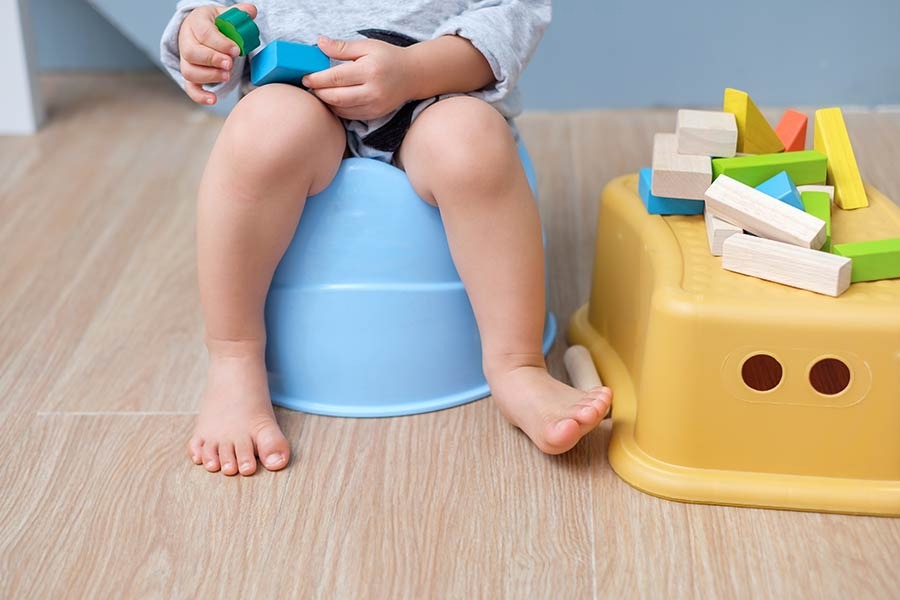
A potty chair or a step stool with a toilet-seat insert, several pairs of training underwear your child likes, a stack of easy-to-remove pants (elastic waist, no snaps or buttons), cleaning supplies for the inevitable accidents, and snacks or small treats if you're using a reward system. Some families also stock a car seat liner or waterproof mat, since trips out of the house during the training weekend are still going to happen.
The shopping list is only half of it. Logistics need just as much attention. Clear the weekend of errands, guests, and travel as much as you reasonably can, since a toddler mid-training does better with a predictable, low-stimulation couple of days than with a trip to a relative's house thrown in. If your home has more than one level, put a potty chair on each floor so your child is never more than a few steps from one when the urge hits. Tell any other caregiver who might be around that weekend, a grandparent, an older sibling, a babysitter, exactly what language you're using ("let's go try the potty" rather than "do you need to go potty?") so the message stays consistent even when you're not the one asking. Keep a spare outfit and a plastic bag within reach in every room your child spends time in, not just the bathroom, since accidents during a training weekend rarely happen conveniently close to the supplies.
How do you set up a reward system?
Keep it simple and immediate. A sticker for sitting on the potty, a small treat or extra story for an actual success, and enthusiastic praise every time, even for attempts that don't result in anything landing in the bowl. The goal is to build a positive association fast, since toddlers respond far better to encouragement in the moment than to a promise of a bigger prize later in the week.
Keep the system flexible once the weekend itself is over, too. Some children stay motivated by stickers for a few more weeks after the first successes; others lose interest in the chart by day three and start using the potty simply because it feels normal by then. Both are fine. The reward system is a bridge to get through the hardest first days, not a permanent fixture, and most families quietly retire it once the new habit holds on its own.
What does each day of the weekend actually look like?
A three-day stretch of potty training in a weekend, not just two days, gives your child more chances to practice and gives you more chances to see whether this is clicking before Monday arrives.
What happens on day one?
Ditch the diapers and pull-ups for waking hours and switch straight to underwear. Set a timer for every 15 to 20 minutes and prompt a potty sit, whether or not your child says they need to go. Expect accidents. Plan on a lot of them. Stay in or near the house so you can respond fast and keep the whole day low-key, since this is about repetition, not covering ground.
What happens on day two?
Stretch the interval between prompts slightly, maybe to 30 minutes, and start watching for your child's own signals rather than running the clock for every single trip. Some kids start initiating on their own by day two. Others are still resisting, and that's within the normal range too. Keep praise consistent and keep accidents low-drama. A short, neutral cleanup and a reminder to try the potty next time works better than a big reaction either way.
What happens on day three?
This is where you find out more than either of the first two days told you. A child who's had a handful of successes and is starting to tell you before they go is showing real progress, even if accidents are still happening. A child who's had almost no successes and is still crying or refusing at every prompt is telling you something too, and it's worth listening to. Try a short trip out of the house, like a walk to the mailbox or a quick errand, to see how the routine holds outside the home before Monday brings a return to work, school, or daycare.
What if accidents or resistance happen during potty training?
Clean up matter-of-factly, remind your child where the potty is, and move on without extended scolding, since scolding tends to add shame without adding any real skill. Bladder and bowel control gets learned gradually, through hundreds of small repetitions, and a wet pair of underwear on day one doesn't mean the weekend is failing. It means your child is somewhere in the middle of that learning curve, same as every other toddler going through it right now.
Resistance is telling you something different. If your child cries, arches away from the potty, or holds their bowel movements out of fear or discomfort rather than simple distraction, pushing harder usually backfires. Backing off for a few days, or a few weeks, and returning to it once the anxiety has faded is a legitimate and common response, not a concession.
What if my child regresses after potty training?
Accidents returning after weeks or months of dry days has a name: regression, and it comes up often enough in pediatric practice that the American Academy of Pediatrics has standing guidance on it rather than treating it as a rare fluke. That guidance starts with the same message every time: address the underlying cause first, and the accidents usually stop following it.
The AAP's guidance on regression lists the usual triggers: starting a new child care setting or preschool, a new sibling or a parent's pregnancy, illness or a death in the family, marital conflict, or a move. Physical causes matter too, and the AAP recommends ruling those out first, since constipation or a urinary tract infection can look exactly like behavioral regression until a pediatrician checks. Once the underlying stressor is addressed, most regressions resolve within days to a few weeks. It's frustrating in the moment, especially after a weekend of real effort, but it's rarely a sign of anything gone permanently wrong.
Stool withholding shows up often enough to call out on its own. It shows up in up to 20% of children during training, according to the AAFP review cited above, and can lead to constipation if it continues. Most cases resolve with a patient, non-punitive approach and don't require anything more dramatic than a temporary pause in active training, sometimes for a month or two, while the child's comfort with bowel movements improves. The same review notes that encopresis, involuntary soiling that continues past the point most children are trained, affects an estimated 1 to 4% of school-age children, a useful reminder that occasional setbacks with bowel control aren't unusual even well after daytime training seems to have stuck.
How does daycare handle potty training in California?
This is the part most potty training articles skip entirely, and it matters more than a sticker chart once Monday arrives and your child heads back to school or child care.
California-licensed child care centers operate under Title 22 of the California Code of Regulations, and it isn't optional guidance. Licensed centers are required to maintain a written toilet-training plan and to provide toileting and diapering assistance that includes instruction and support in handwashing afterward, as part of the center's licensed hygiene and sanitation procedures. You can read the underlying requirements in the Title 22 child care center regulations and the related definitions section on Cornell's Legal Information Institute. Practically, that means a licensed Northridge program isn't improvising when your child arrives mid-training. There's a written plan behind what happens in the bathroom.
The single factor most consistently linked to smoother training, according to consumer-facing sources like Care.com's guide to potty training with daycare and brightwheel's daycare potty training guide, is consistency between home and center. Same cues, same phrases, same praise-and-reward approach, so your toddler isn't relearning the routine every time they switch environments. Ask your center directly what method they use, whether they'll take a child in pull-ups or underwear only, and which staff assist with bathroom trips, before you start your weekend rather than after.
At Strong Roots Preschool in Northridge (CCLD license #195700760), that written toilet-training plan and daily coordination with parents is standard practice, not something bolted on for families mid-training. Our teachers can tell you exactly how a child's daytime routine at 9054 Darby Ave lines up with what you're doing at home, which cuts down on the "trained at home, back in diapers at school" confusion that derails a lot of families in week two.
Strong Roots serves children from infant care through toddler, preschool, and pre-K, plus after-school care, which means a toddler working through potty training in a weekend might be moving between a toddler room and a preschool classroom during the very months training is happening. Ask which classroom your child would be in at each stage and how the toilet-training plan travels with them between rooms, since a center covering that many age bands needs the same Title 22 coordination for a two-year-old as it does for a four-year-old headed to pre-K. If you want to talk through timing before your training weekend, schedule a tour of our Northridge classrooms and ask our team how we'll support whatever stage your toddler is at.
How do you handle nighttime potty training?
Expect nighttime dryness to lag daytime training by a wide margin, and don't treat a wet pull-up at night as a sign that daytime training didn't take. Roughly 40% of U.S. children still experience nighttime bedwetting at ages where daytime training is otherwise complete, and most young children have some nighttime accidents until around age four regardless of how well daytime training went, according to the AAFP review and the ParentingScience research summary cited earlier in this guide.
Practically, that means keeping your child in overnight pull-ups or a diaper well after daytime underwear has become routine is normal, not a failure to finish the job. Limiting fluids in the hour or so before bed and having your child use the potty right before lights-out can help, but nighttime dryness is largely a matter of bladder capacity and hormonal development catching up, on its own schedule, separate from the skills potty training in a weekend actually builds.
If your child attends daycare or preschool, ask how naptime is handled during this stretch, too. Title 22's diapering and toileting assistance rules for California centers cover rest-time supervision as well as the after-lunch bathroom routine most parents picture, so a licensed center should have a clear answer for whether your child naps in underwear, a pull-up, or whatever you're using at home that week. Matching that choice between home and school avoids the confusing situation where a child gets treated as fully trained at 3 p.m. and handed a pull-up for nap time an hour earlier.
What if it doesn't work in a weekend?
Potty training in a weekend doesn't always click by Sunday night, and that's common, not a verdict on your child or your parenting. A weekend is a starting point for building momentum, not a deadline your family either meets or fails.
The Potty School's guide to long-weekend training frames it well: if your child is showing strong resistance or almost no progress after several days of real effort, that's usually a sign readiness wasn't quite there yet, not that you did something wrong. The evidence-aligned move is to pause for a few weeks and try again once more of the readiness signs from earlier in this guide start showing up. Full daytime training, even in families where everything goes reasonably well, more typically takes three to six months of consistent routine at home and in coordination with daycare, per brightwheel's guidance for families working with child care providers. A rough weekend is a data point on that longer timeline, not the whole story.
If you're weighing how a Northridge program would support your toddler through the ups and downs of that longer timeline, from a rough first weekend through the weeks it actually takes to stick, our team at Strong Roots is glad to walk through it. Call (323) 990-8181 or email info@strongrootspreschool.com, and we'll talk about where your child is right now, not where a blog post says they should be.