








Why Character Values Matter in Early Childhood Education
Parents don't need a research study to sense that the early years shape who a child becomes. But if you want to know whether character values in early childhood education are backed by more than instinct, the answer is yes, and the evidence is more specific than "be kind." Developmental psychologists, education researchers, and organizations like NAEYC have spent decades studying how young children build empathy, moral reasoning, and self-regulation, and the findings point to concrete, age-and-stage patterns that parents and teachers can actually work with.
This piece walks through what that research says: why the early years are a high-leverage window for values education, how moral reasoning develops on a predictable timeline, why story-based teaching (including Bible stories) is an effective vehicle for building empathy, and how all of this connects to school readiness. None of it requires you to take anything on faith alone. It's laid out with sources so you can check the claims yourself.
That's the frame for parents of toddlers through elementary-age kids alike. The research below spans early childhood and school-age samples, and the pattern holds in both: values education isn't a preschool-only phase that fades once formal academics start. It keeps mattering as kids move into elementary school and start navigating friendships, group work, and bigger feelings on their own.
Why does character education matter so much in the early years?
Because social-emotional skills aren't a side project to academic learning. They're part of the same system. The National Association for the Education of Young Children (NAEYC) treats social-emotional development as just as important to a child's learning as academic development, since emotions directly affect attention, memory, relationship-building, and physical and mental health. NAEYC's framework identifies self-awareness, empathy, and resilience as foundational skills for success in school, work, and life, not extras layered on top of "real" learning.
This is why the NAEYC framework doesn't stop mattering once a child leaves the toddler room. Self-awareness, empathy, and resilience are the same skills a kindergartner needs to handle a disagreement on the playground and the same skills a third-grader needs to work through a group project without a meltdown. The age changes. The underlying skill set doesn't.
That framing matters because it reorders the priority list a lot of early-childhood programs quietly follow. If empathy and self-regulation are prerequisites for academic learning to stick, rather than a nice-to-have, then time spent on character values in early childhood education isn't time taken away from letters and numbers. It's time spent building the scaffolding those letters and numbers get hung on later.
The outcomes data backs this up. Character-education researchers Berkowitz and Bier found that 82% of the character-education programs they studied produced measurable improvements in behavior outcomes, according to a summary reported by structural-learning.com. Separately, schools that implement character education report increases in academic performance and attendance alongside decreases in disciplinary problems, per Teacher Created Materials. Neither finding is a coincidence. A child who can name a feeling, wait a turn, or notice when a classmate is upset has an easier time sitting through a lesson than one who can't do any of that yet.
Researcher Carly Kidron defines character education as "a deliberate attempt to foster the skills, attitudes, motives and beliefs that lead to prosocial and ethical behaviour" (2017, via structural-learning.com). The word doing the real work in that definition is deliberate. Kindness and self-control aren't things children simply absorb by osmosis. They get built the same way any other skill gets built: through repeated, intentional practice.
What does the research say about moral development in young children?
It says preschoolers reason about right and wrong differently than adults do, and that's normal, not a red flag. Lawrence Kohlberg's widely cited framework places children roughly ages 3 to 4 in what's called the preconventional level of moral development, specifically Stage 1, the "obedience and punishment orientation." At this stage, a child judges whether something is right or wrong mostly by whether it gets rewarded or punished by an adult, not by an internalized sense of principle. Kohlberg's stages of moral development describe this as an expected developmental phase every child moves through, not evidence that something is wrong with a particular kid.
What is Kohlberg's preconventional stage, and why does it matter for preschoolers?
It matters because it tells teachers and parents what kind of values teaching will actually land at this age. A 3-year-old who shares a toy "because Miss Ani said sharing is nice" isn't demonstrating a shallow understanding of kindness. She's demonstrating exactly the developmental stage she's supposed to be in. The goal of early character education isn't to skip that stage. It's to give children enough consistent modeling, story, and practice at this stage that the later transition toward more internalized moral reasoning has solid ground to build on.
This is also why consistency matters more than any single lesson. A child working through Stage 1 needs to hear the same values reinforced across contexts, home, classroom, and daily routine, before that reinforcement can turn into something the child owns rather than something an adult enforces. A single conversation about sharing rarely changes behavior. Dozens of small, repeated moments do.
Does teaching values through stories actually work?
Yes, and the research on this is more specific than "stories are nice." Story-based and roleplay-based approaches have been shown in early-childhood studies to significantly increase measured empathy in children. One study on storytelling and roleplaying media found that story engagement activates emotional and neural processing pathways similar to real-life experience, which supports emotional awareness, perspective-taking, and prosocial thinking in young children.
A separate action-research study looking at structured storytelling sessions found statistically significant increases in empathy scores, with large effect sizes. That study, which focused on older children ages 10 to 12 rather than preschoolers, treated empathy as a developed capacity built through emotional and social growth over time, rather than a fixed trait some kids have and others don't. Combined with the early-childhood findings above, the pattern holds across a wide age range: story is a mechanism, not just a mood-setter.
How does storytelling build empathy in young children?
Mainly through perspective-taking. A well-told story puts a child inside someone else's situation, what that character wants, fears, or needs, and asks the child to sit with that for a few minutes before the story resolves. That's a rehearsal for real-life empathy, which requires the same skill: pausing to consider what another person might be feeling before reacting. Roleplay adds a second layer by having the child physically act out that perspective rather than just hearing about it, which the research above ties to stronger empathy gains.
The choice of story matters too. Stories with a clear character in a difficult situation, a moral tension, and a resolution tend to work better than stories that are purely entertaining, because they give the child something to reason through rather than just something to watch happen.
How do Bible stories teach empathy, kindness, and moral reasoning?
They work through the same storytelling-empathy mechanism described above, with a specific set of well-known narratives as the vehicle. The Good Samaritan is commonly used to illustrate kindness and compassion, David and Goliath to illustrate courage, and the Prodigal Son to illustrate forgiveness. Each one puts a child in another character's position and asks, implicitly, what that person needed and how it felt to receive or offer help.
That's not a separate mechanism from general storytelling-based empathy building. It's the same one, applied to a specific set of narratives that happen to be familiar to many families and easy for young children to follow. A parable like the Good Samaritan works structurally the same way a well-chosen fable or picture book does: a character in trouble, a choice about how to respond, and a resolution the child can reason about afterward.
One claim shows up often in this kind of content, and it deserves to be dropped: that children raised with faith-based instruction are automatically more caring than other children. No rigorously sourced study backs that up. The more useful, more honest version of the story is this: story-based values teaching works because of how stories engage a developing brain, and Bible stories are one credible, values-rich source of that kind of story among several. They are not a shortcut that bypasses the need for consistent modeling and practice.
Strong Roots Preschool in Northridge includes a weekly Bible Study class as one of several enrichment offerings, alongside Armenian language, chess, math, arts and crafts, and STEAM. For a full look at how that class is structured, including its non-coercive, story-then-conversation format, see our companion piece on integrating Bible study into Northridge childcare.
Is character education important for school readiness?
Yes, because school readiness itself isn't defined as academic skill alone. It's commonly defined as cognitive, social, emotional, and physical development together, with self-regulation specifically named as a key readiness factor. A child who can identify their own frustration, wait for a turn, and follow a multi-step routine is better positioned to succeed in a kindergarten classroom than a child who has strong letter recognition but struggles to sit still or handle disappointment.
The long-term picture backs this up too. Research from Child Trends found that improved school readiness, which includes those social-emotional and self-regulation components alongside cognitive skills like early literacy and counting, is associated with better academic outcomes through elementary and high school, and modest but real improvements in young-adulthood outcomes like bachelor's-degree attainment and earnings. That research frames this as a compounding effect: the earlier the foundation gets built, the more years there are for it to pay off.
This is the strongest practical case for taking character values in early childhood education seriously as a curriculum priority rather than an extracurricular nice-to-have. It isn't competing with school readiness. It's one of the components school readiness is made of.
How do values-based early education programs differ from purely academic ones?
Purely academic programs concentrate on cognitive skills: letters, numbers, early literacy. Values-based programs add deliberate, structured attention to prosocial and ethical development on top of that, treating it as an equal partner rather than an afterthought squeezed in when time allows.
The research suggests this isn't just a philosophical preference. It shows up in outcomes. The most-cited large-scale evidence here comes from Durlak and colleagues, who in 2011 published a meta-analysis in Child Development covering 213 school-based, universal social-emotional learning (SEL) programs and more than 270,000 K-12 students. Participants in SEL programs showed an 11-percentile-point gain in academic achievement compared with control groups, along with improvements in social and emotional skills, attitudes, and behavior. That study covers K-12 broadly rather than preschool specifically, but the direction of the finding, that SEL and academics move together rather than trading off against each other, lines up with everything else in this article.
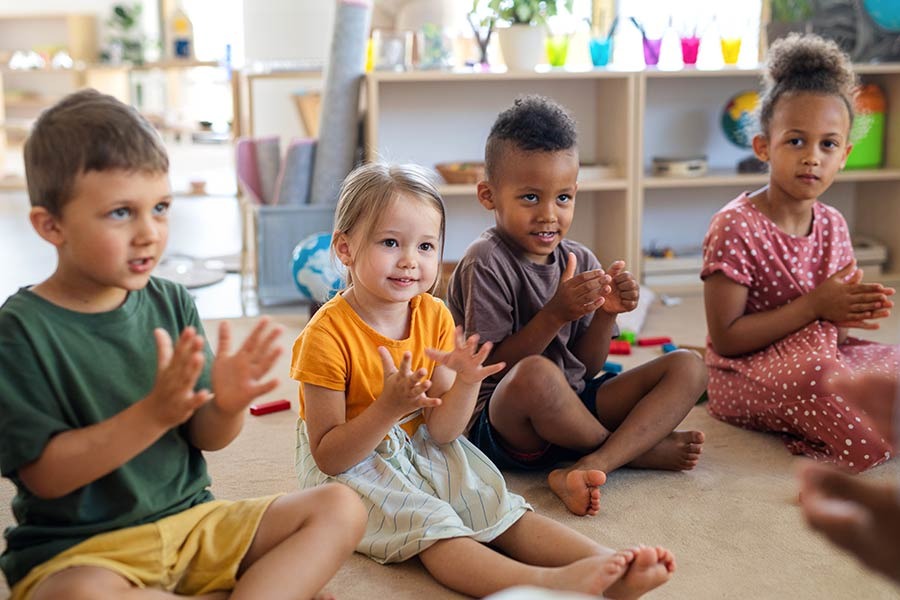
In practice, a values-based program doesn't look like an academic program with a chapel service bolted on. It looks like a classroom where a teacher pauses a conflict over blocks to talk through what each child needed, where story time includes a few minutes of "what do you think she was feeling," and where routines like greeting classmates or cleaning up together get treated as values practice, not just housekeeping.
None of that requires a script. It requires adults who treat a spilled cup of paint or a disagreement over who goes first as a teaching moment rather than an interruption to the real lesson. Over months and years, those small moments add up to the values education children actually remember, more than any single unit or worksheet does.
How does this show up in a Northridge classroom?
At Strong Roots Preschool, character-values teaching happens across the day rather than in a single set-aside period, through modeling, discussion, and consistent routines, with the weekly Bible Study class serving as one structured touchpoint among several enrichment offerings. Programs run from Infant Care through After School (K-5th), so the same values framework travels with a child from their earliest months through elementary school rather than resetting each time they move up a room. For the full breakdown of how the Bible Study class fits into the weekly rotation and what its format looks like, that's covered in our companion article on Bible study at Strong Roots.
Parents who want to see this in practice rather than read about it are welcome to schedule a visit. Watching a values conversation happen in real time, whether it grows out of a Bible story, a picture book, or an everyday disagreement between kids, tends to say more than any list of program features.