





Before the ABCs: a fun, playful path to early literacy activities for preschoolers
Long before your child can sound out a single word, they're already doing the work that makes reading possible. Early literacy activities for preschoolers aren't flashcards or drills. They look more like rhyming games, silly songs in the car, pointing at pictures in a board book, and letting a two-year-old "read" a story back to you in a made-up language that only she understands. The American Academy of Pediatrics recommends reading aloud daily starting in infancy, because that shared time supports brain development, vocabulary, and language skills long before a child ever sees a worksheet.
At Strong Roots Preschool in Northridge, this is the whole philosophy in miniature. We treat literacy as something a child grows into through play, not something you impose on them at a desk. Below is a plain-English guide to what early literacy actually is, what the research says about it, and how you can build it into your everyday life with your toddler or preschooler, whether or not you ever set foot in our classrooms.
What is early literacy, and why does it start before the alphabet?
Early literacy is the collection of skills, habits, and attitudes a child builds before they can read or write on their own. It includes vocabulary, the ability to notice sounds in spoken words, an understanding of how books and print work, and, maybe most importantly, a genuine enjoyment of stories. None of that requires knowing letters yet.
Think of it this way. A child who has never memorized the alphabet but who loves being read to, who can guess what happens next in a familiar story, and who notices that "cat" and "hat" sound alike is further along the literacy path than a child who can recite the ABC song but has no real interest in books. The skills underneath reading, like vocabulary and the ability to play with sounds, are what predict whether a child becomes a strong reader later. Letter knowledge matters too, but it's one piece, not the whole picture.
This is why we don't lead with the alphabet at Strong Roots. We lead with conversation, songs, story time, and play, and let letter recognition grow out of that richer foundation.
When should I start reading to my child?
Start now, whatever your child's age. The AAP's guidance is to read aloud daily beginning in infancy, and its clinical report on literacy promotion frames shared reading as more than a pre-reading exercise. It's a way of building a nurturing relationship during a critical window of brain development, and it's linked to a broader vocabulary, stronger language skills at school entry, and fewer behavior problems down the road.
There's no age that's too early and, honestly, no age that's too late to start either. A newborn won't follow the plot of a picture book, but they'll respond to your voice, your face, and the rhythm of the words. By the time a child is a toddler, that daily habit has already become something they expect and look forward to. Programs like Reach Out and Read, a pediatric literacy initiative endorsed by the AAP, have found that parents who participate are roughly two and a half times more likely to read regularly with their children than parents who don't, and the kids in those families show stronger language development as a result. The takeaway isn't that you need a formal program. It's that consistent reading, in whatever form it takes at your kitchen table, works.
What are pre-reading skills, and how do they build toward reading?
Pre-reading skills, sometimes called emergent literacy skills, are the building blocks that come before a child can decode words on a page. The two that researchers point to most consistently are phonological awareness and print awareness, and both develop through play and everyday exposure long before formal instruction starts.
What is phonological awareness, and does it matter before kindergarten?
Phonological awareness is the ability to notice and play with the sounds inside spoken language, separate from what the words actually mean. It's clapping out the syllables in "el-e-phant." It's noticing that "sun" and "fun" rhyme. It's the game where you ask "what word do you get if you take the /b/ off of 'bat'?"
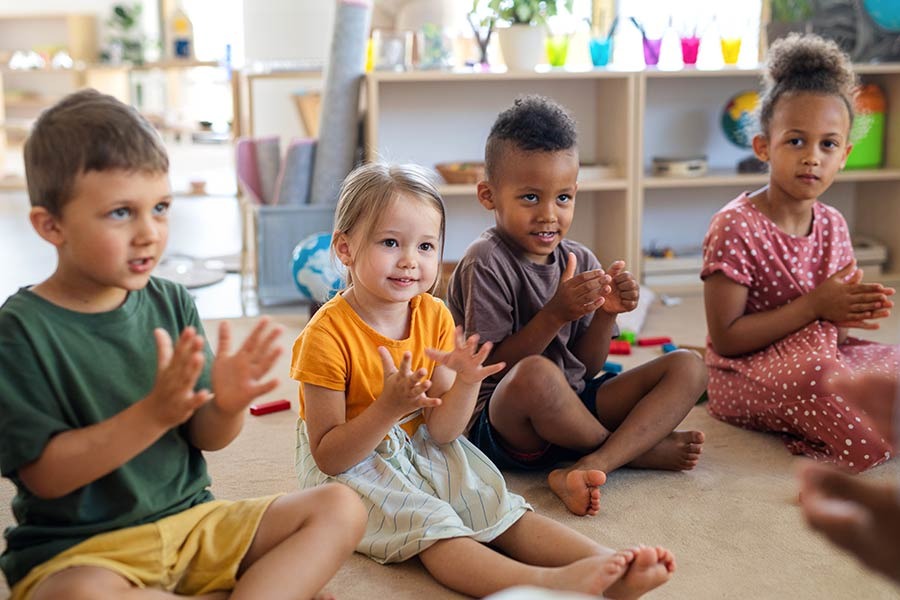
It matters a great deal, and it matters early. A National Early Literacy Panel meta-analysis identified phonological awareness as one of the strongest predictors of how well a child will read later on, right alongside print and alphabet knowledge. That's a striking finding, because none of that requires a child to already know their letters. NAEYC's guidance for preschool classrooms recommends that teachers build phonological awareness into the natural flow of the day for children ages three to five, through songs, rhymes, and word games, rather than isolated drills. That's precisely how we approach it in our classrooms: sound play woven into circle time, transitions, and free play, not a worksheet handed out at a table.
What is print awareness?
Print awareness is a child's understanding that the marks on a page actually mean something. It includes knowing which way is the front of a book, understanding that pages turn in order, and grasping that in English, print runs left to right and top to bottom. Reading Rockets describes print awareness as a foundational pre-reading skill that develops well before a child can identify individual letters or sound out words.
You can build this one almost by accident. Let your child hold the book and turn the pages during story time. Run your finger under the words as you read every so often, so they start to connect the print to the sounds coming out of your mouth. Point out signs and labels when you're out and about: the stop sign, the cereal box, the name on their cubby at preschool. All of it teaches the same underlying lesson, that print carries meaning, and it's one of the quieter early literacy skills a child picks up long before kindergarten.
What's the difference between literacy and reading?
Reading is the specific skill of decoding printed words and understanding what they say. Literacy is the much wider umbrella that reading sits inside, covering vocabulary, comprehension, the ability to tell and follow a story, print awareness, and phonological awareness. A three-year-old who cannot read a single word can still be building real literacy skills every time she listens to a story, predicts what happens next, or notices that two words rhyme.
This distinction matters for parents because it changes what "working on literacy" should look like before kindergarten. Your four-year-old is not behind if he doesn't recognize letters yet. What matters more at this stage, based on the research above, is vocabulary, phonological awareness, print awareness, and a genuine love of stories, the foundation that formal reading instruction gets built on top of once a child starts school.
How can I make reading aloud more interactive?
The single biggest lever here is a technique called dialogic reading, and it's simpler than it sounds. Instead of just reading the words on the page start to finish, you pause, ask open-ended questions, and build on whatever your child says back to you. "What do you think the bear is going to do next?" "Why do you think she looks so worried?" "That reminds me of when we went to the beach. Does it remind you of anything?"
Research on parent-led dialogic reading has found it boosts both expressive and receptive vocabulary in toddlers and preschoolers compared to standard read-aloud sessions where the adult just reads straight through. The What Works Clearinghouse, which reviews education interventions for evidence of actual effectiveness, has reached similar conclusions.
Here's why it works so well. A child who is asked to predict, explain, or connect a story to their own life is doing far more mental work than one who is simply listening. They're building vocabulary, practicing narrative structure, and forming the habit of thinking critically about what they read, all while it still feels like a conversation with someone they love rather than a lesson.
You don't need a script for this. If your child interrupts the story to ask an unrelated question, follow it. If they want to linger on one page because they spotted something funny in the illustration, let them. Dialogic reading works precisely because it follows the child's interest instead of a fixed agenda.
What are some playful early literacy activities I can try at home?
You don't need a curriculum to build these skills at home. A lot of it is just paying attention to the literacy that's already hiding inside ordinary moments.
Rhyming games in the car or at bath time. "I spy something that rhymes with 'car.'" It costs nothing, takes no supplies, and builds phonological awareness every time you play it.
Letting your child "read" you the story. Once a book is familiar, hand it back to your child and let them tell it to you in their own words, even if what comes out barely resembles the actual text. This builds narrative sense and print motivation, the simple desire to engage with books, which matters just as much as any specific skill.
Cooking together and talking through it. Reading a recipe out loud, pointing at the ingredient list, and talking through the steps introduces new vocabulary and shows a child that print serves a real purpose in daily life, not just at story time.
Singing and finger plays. Songs with repetitive, rhythmic language ("The Itsy Bitsy Spider," "Old MacDonald") are doing double duty. They build vocabulary and they train a child's ear to hear syllables and sounds, which is exactly what phonological awareness is.
Labeling the world around them. Sticky notes on the fridge, the door, and favorite toys with their names written out help a toddler start to connect written words with the objects they represent, one small step toward print awareness.
Story time with real back-and-forth. As covered above, this is where dialogic reading comes in. Ask questions, follow tangents, and let the story become a conversation rather than a monologue.
Puppet shows and pretend retelling. Acting out a favorite story with stuffed animals, puppets, or just your hands gives a child practice putting events in order and using new vocabulary out loud, without the pressure of an adult correcting every word.
Word hunts around the house. Ask your child to find something that starts with a certain sound, or something whose name rhymes with a word you pick. It turns cleanup time or a walk to the mailbox into casual phonological awareness practice.
None of these require an app, a workbook, or a set schedule. They require a few spare minutes and a willingness to treat literacy as something you build together, not something you deliver.
A print-rich home helps too. Keep a basket of board books within your toddler's reach, rotate in new titles from the library, and let your child see you reading your own book, a recipe, or a grocery list. All of it reinforces the same lesson: print is everywhere, and it matters. None of this needs to be elaborate. A shelf at eye level and a few minutes of attention most days will do more than an expensive workbook a child never opens.
How does a multi-sensory, play-based classroom build literacy skills?
Children don't learn best by sitting still and listening. They learn by touching, moving, singing, and building, and literacy is no exception. NAEYC's guidance on early language development emphasizes that strong preschool literacy instruction happens through meaningful language use, listening and responding to stories, answering open-ended questions, having extended conversations, and encountering new vocabulary in context, rather than through isolated worksheet drills.
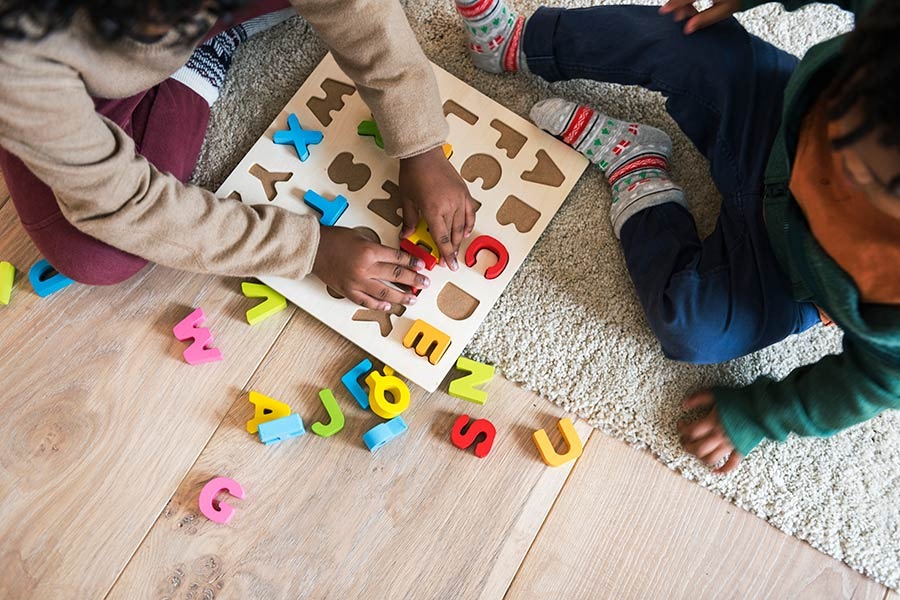
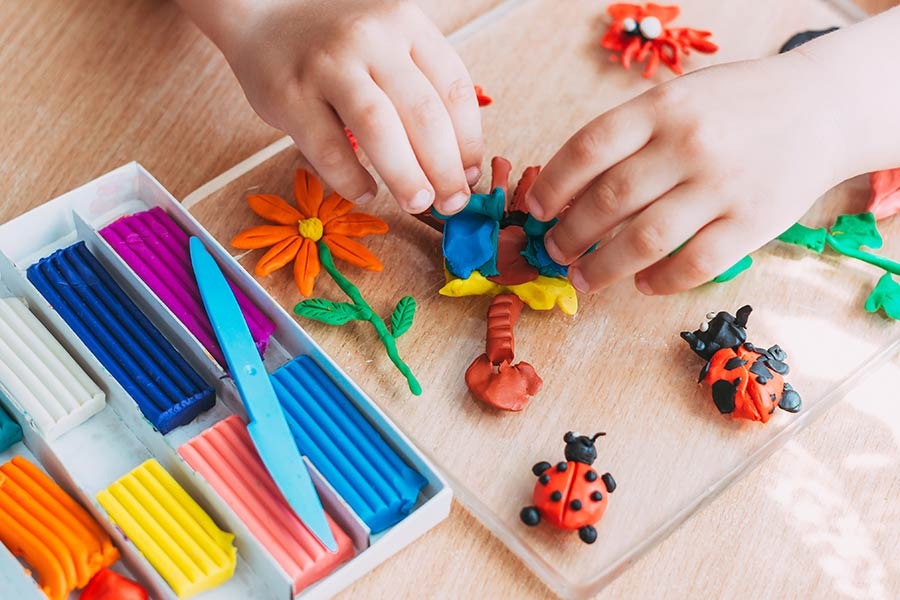
That's the model our classrooms are built on, and it's how we put early literacy research into practice every day rather than leaving it in a binder. Strong Roots follows a play-based, Montessori-inspired curriculum with STEAM woven throughout, so a lesson about the letter "S" might turn into a sensory bin full of sand, shells, and small toy snakes, or a rhyming game might turn into a movement activity where children hop from word to word taped on the floor. Literacy gets connected to touch, sound, and motion instead of living only on a page.
A separate strand of NAEYC guidance, on using the whole "village" to raise a reader, points out that children build literacy through relationships, not just materials. That's part of why classroom size, teacher warmth, and genuine back-and-forth conversation with the adults in a child's life matter so much. A stack of the right books sitting untouched on a shelf doesn't do much on its own. What moves the needle is an adult who reads them, asks questions about them, and makes story time feel like connection rather than a task to get through.
Ready to see what a literacy-rich, play-based classroom actually looks like day to day? Schedule a tour of our Northridge classrooms and watch our multi-sensory approach to early literacy activities for preschoolers in action.
What if my child isn't interested in books yet?
This is one of the most common worries we hear from parents, and it's a normal one. Not every child takes to sitting still for a story right away, and that doesn't mean anything is wrong.
Start by following their interest rather than fighting it. If your child is obsessed with trucks, find truck books. If they'd rather flip through the pages themselves than have you read every word, let them. The dialogic reading research above backs this up: engagement and back-and-forth interaction matter more than reading a book cover to cover in one sitting. A wiggly toddler who touches the pictures, asks questions, and wanders off after two pages is still building literacy skills, just on their own terms.
Keep sessions short and low-pressure, offer choices between two or three books instead of forcing one specific title, and read in whatever position works, on the floor, in a lap, standing up flipping pages at the shelf. The goal at this stage isn't stamina. It's building a positive association between books and connection with a caregiver, so that interest grows naturally over time.
How does Strong Roots Preschool build early literacy in Northridge?
Strong Roots Preschool is a CCRC-licensed program (License #195700760) located at 9054 Darby Ave in Northridge, CA. Our curriculum blends play-based learning, Montessori-inspired materials, and STEAM activities, and it was built by founder Narine Mazmanyan, who brings a background in psychology, pedagogy, and healthcare to how our classrooms are designed.
Literacy isn't a separate subject squeezed into the schedule here. It's threaded through circle time songs, sensory play, storytelling, dramatic play corners, and the everyday conversations between teachers and children throughout the day. Rhyming, sound games, and print-rich environments (labels, name cards, books at a child's eye level) show up across the classroom, not just during a designated reading block. The goal is a program where children encounter the research-backed building blocks of literacy, phonological awareness, print awareness, rich vocabulary, and a genuine love of stories, inside a day that still feels like play.
If you're a Northridge parent trying to figure out whether a preschool's approach to early literacy is more than just marketing language, the best way to know is to see a classroom in session. Contact us or call (323) 990-8181 to schedule a visit, and see how our teachers weave literacy-building into a typical day.