








Quality Over Quantity: What Makes Screen Time Actually Meaningful for Toddlers?
If you've ever handed your toddler a tablet just to get five minutes to make dinner, you already know the guilt that follows. Here's the reassurance: quality screen time for toddlers comes down to what's on the screen, whether you're nearby, and what happens before and after the viewing, not a specific number of minutes on a clock.
That distinction matters more than most parenting advice admits. Pediatric groups have spent years telling parents to watch the clock. The more useful question is what the clock doesn't measure: is your toddler watching alone or with you, is the content paced for a two-year-old's attention span, and is the screen replacing sleep or family time it shouldn't be replacing.
This guide walks through what the research says, not just the one-hour rule you've already heard, but the mechanisms behind why some screen time helps toddlers learn and some just fills the silence.
Most families land somewhere in the middle of the guidelines on any given day, and that's normal. The goal here is a workable framework: know the general age ranges, understand why quality outweighs a strict countdown clock, and build habits that make the daily decisions easier instead of harder. That's true whether your toddler is eighteen months old and just starting to see a screen, or five and about to age out of these guidelines altogether.
How Much Screen Time Is Okay for a Toddler?
The honest answer depends on age, and the two major guidance bodies agree on the broad strokes even though their numbers aren't identical.
What Do AAP Guidelines Say by Age?
The American Academy of Pediatrics draws a fairly firm line under 18 months: outside of video-chatting with a relative, screen media isn't recommended at that age. Infants this young learn best from real-world interactions, and heavy solo screen use in the first year and a half has been linked to slower language and social development.
Between 18 and 24 months, the guidance softens slightly. If you do introduce digital media at this stage, the AAP's position is to choose high-quality programming and watch it together, since sitting with your toddler is, in the AAP's words, how kids this age learn best from a screen at all.
From age two through five, the number most parents have heard shows up here: up to one hour a day of high-quality content. But the AAP's more recent framing carries more weight than that hour figure on its own. Rather than treating the time limit as the whole policy, the current guidance treats quality, context, and conversation as the priorities, with the hour as one piece of a larger picture. Screens shouldn't be crowding out sleep, physical activity, family time, or unstructured play, and the AAP recommends keeping bedrooms and mealtimes device-free.
The Academy also nudges families toward shared devices instead of a toddler's own personal tablet, since a shared device naturally puts a parent in the room to co-use and monitor what's happening.
What Do WHO Guidelines Add to the Picture?
The World Health Organization's numbers run a bit stricter. They frame screen time as one part of an entire 24-hour routine, alongside sleep and physical activity, not as an isolated behavior to manage. Under age one, the WHO recommends no screen time at all. At age one, the same guidance holds. By age two, the ceiling is one hour, with less considered better. Ages three and four carry that same one-hour ceiling for sedentary screen use.
Two details make the WHO framing more specific than it first looks. First, these guidelines cover sedentary screen time (television, videos, computer games) and carve out live video chatting as the one exception for children under two. Second, the WHO has treated screen time this way since it first issued these recommendations in 2019.
Between the AAP and WHO, the practical takeaway for most families is simple: for children under two, less is better and video calls with grandparents are fine; for ages two through five, aim for an hour or under of the kind of content that earns its place on the screen.
What Actually Makes Screen Time "Quality" Instead of Just Noise?
This is the part most articles skip. They'll tell you to look for "educational" shows and leave it at that. The research explains what separates content that helps a toddler's brain from content that just occupies it.
Why Do Pacing and Repetition Matter in Kids' Media?
Toddlers process information more slowly than older kids and adults, and shows built with that in mind tend to slow down and repeat their core ideas without rushing through the plot. Sesame Workshop's content is built deliberately around slower pacing and repeated messaging, on the theory that a toddler needs to hear an idea more than once, in more than one context, before it sticks.
That's a useful filter when you're standing in front of a streaming menu with no idea which show is worth your toddler's hour. Fast cuts, rapid scene changes, and constant novelty might hold attention in the moment, but attention isn't the same thing as learning. Slower, more repetitive content gives a toddler's developing brain time to absorb what's happening, not simply react to it.
How Do Educational Shows Get Tested Before They Air?
Here's a detail most parents have never heard, and it's a genuinely useful one: some educational media gets tested on real preschoolers before it's released. Sesame Workshop's process involves showing episodes to actual preschool-age kids, then measuring their attention, engagement, and whether the intended lesson landed. If kids in that testing group don't learn what the episode was meant to teach, the episode gets reworked or scrapped before it ever airs.
That formative-testing process is the difference between a show that markets itself as educational and one that's been checked against how real toddlers respond. It also connects to something researchers have measured downstream: repeat viewing of playful problem-solving episodes has been linked to measurable gains in children's hands-on problem-solving, with kids using more strategies and working more efficiently after watching. Content built and tested this way does something most cartoons never attempt.
There's no independently verified, universal list of which specific shows or apps clear this bar. Company marketing copy isn't the same as research. The defensible approach is to judge media by this process (slow pacing, repeated core ideas, real testing with kids), not by a logo or a brand name.
For parents scrolling through a crowded lineup of shows and apps, the practical version of this research is simple: favor media that feels unhurried, repeats its core lesson more than once, and comes from a studio known for testing content with real kids, not just marketing it to them. That's what quality screen time for toddlers looks like in practice.
Is Co-Viewing With Your Toddler Really Necessary?
Short answer: yes, and there's a mechanism behind why, not just a general recommendation to "watch together."
What Happens When You Narrate or Ask Questions During a Show?
Joint media engagement, the research term for using media together with your child, as opposed to handing them a device and stepping away, is associated with increased learning from media during early childhood. The mechanism isn't mysterious: when a parent narrates what's happening, names new words, or asks a simple question about the story, the toddler gets a layer of language and context that the show alone doesn't provide.
One study found that 30-month-olds learned more new words when watching video with a parent modeling and narrating than toddlers who watched the same content alone. That gap between watching with a parent and watching alone is the whole case for co-viewing in one data point.
A carryover effect shows up here too. Research on co-viewing has found that the richer language parents use during a show tends to show up again later, during unrelated free play. The vocabulary doesn't stay locked inside the viewing session; it becomes part of how the child talks afterward.
How Does Co-Viewing Help With the "Video Deficit Effect"?
Researchers use the term "video deficit effect" to describe something well-documented in early childhood: young kids reliably learn less from a screen than they do from the same information delivered in person. A toddler watching an adult stack blocks on video will typically pick up less than a toddler watching the same demonstration happen live in the room.
An adult who co-views doesn't erase that gap, but the research suggests it narrows it. Scaffolding strategies, like pointing things out, repeating the important moments, and asking your toddler what they think happens next, give the child support that the screen by itself can't. In practical terms, that's the case for sitting down next to your toddler instead of using the screen as a solo babysitting tool, even for content you'd consider high quality on its own.
Put simply, staying in the room and saying a few words about what's happening turns the screen into something you're doing with your toddler. That's a small shift, but it's most of what separates quality screen time for toddlers from time that just fills a gap in the afternoon.
Is Screen Time Before Bed Actually Bad for Toddlers?
Real research backs this up, and it's more specific than the usual "no screens before bed" advice you've probably already heard.
What Does the Sleep Research Say?
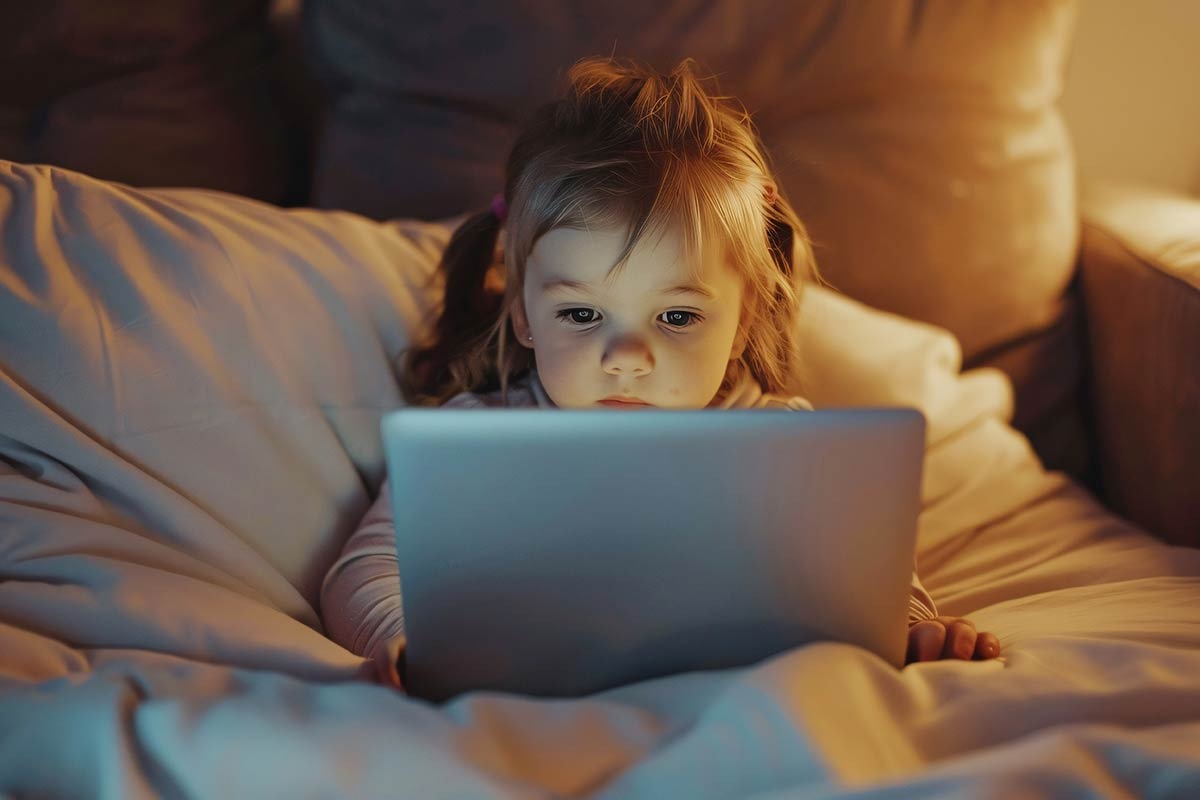
Studies looking at children from birth to age five have found that greater screen use is associated with later bedtimes, longer time to fall asleep, shorter total sleep, and more night wakings, along with more sleep problems reported by parents overall. That's a fairly consistent pattern across the research, not a single outlier study.
Part of the reason likely comes down to light exposure itself, separate from whatever content is on the screen. Researchers at the University of Colorado Boulder found that an hour of bright light exposure at bedtime cut preschoolers' melatonin levels by 88 percent, and that suppression lasted roughly 50 minutes even after the lights went out. Melatonin is the hormone that signals to the body it's time to sleep, so a sharp drop right before bed works directly against a toddler settling down.
This part of the research is less settled than it sounds. A more recent study looking specifically at blue-light-filtered tablets found that this particular type of screen use didn't significantly worsen toddlers' sleep compared to no screen at all. The evidence on blue light specifically is still mixed, and that finding doesn't cancel out the broader bedtime-screen research above. It just means the picture is more complicated than "all screens equally disrupt sleep."
How Much Buffer Time Before Bed Is Enough?
The practical guidance coming out of this research lines up with something simple: turn screens and devices off at least an hour before bedtime, and dim the lights in the house during that same window. That gives melatonin a chance to rise on its own schedule, undisturbed by bright light and a screen competing at once. Keep the wind-down itself simple too, a bath, a couple of books, and low light, done in roughly the same order most nights. Getting the exact minutes right matters less than keeping that order consistent, since a familiar routine gives melatonin the same dark, quiet cue every night instead of a different scramble each time.
How Do You Set Screen Time Limits Without a Daily Fight?
Most of the tension around screen time comes from limits that get negotiated fresh every single day, not from the screen itself. Renegotiating the rule each time turns every screen-off moment into a standoff.
What's a Family Media Plan and Do You Need One?
The AAP recommends building a Family Media Plan, a free tool for setting household media rules before you're in the middle of a meltdown trying to invent them on the spot. The value isn't the document itself. It's deciding, ahead of time and outside the heat of the moment, what your family's screen rules are: when screens are allowed, what counts as acceptable content, and where the lines sit.
Pediatric researchers also reference a broader framework sometimes called the "5 Cs of Media Use" (Child, Content, Calm, Crowding Out, Communication), a shorthand for thinking through these decisions with a toddler's age and temperament in mind. It's a useful checklist, though the details of your own plan matter more than memorizing the framework.
How Do Screen-Free Zones Make Limits Easier to Keep?
Rather than negotiating screen time fresh every day, the research points toward keeping certain spaces and times consistently screen-free: bedrooms and mealtimes are the two the AAP calls out specifically. When a toddler learns that screens never show up at the dinner table or in the bedroom, there's nothing left to argue about. The rule already exists before the moment arrives, so nobody has to decide it on the spot.
Shared, common-area devices instead of a toddler's own tablet do similar work. When the device lives in a shared space and gets used with a parent nearby, screen time naturally stays visible and bounded instead of becoming something a toddler disappears with into another room.
Taken together, these three habits work as a system, not as separate rules a parent has to remember and enforce one at a time. A Family Media Plan sets the expectation, screen-free zones make it automatic, and shared devices keep a parent close enough to help without a daily negotiation. Parents who set the rule once, before the conflict starts, spend far less energy every day than parents renegotiating it from scratch.
How Does Strong Roots Approach Screen Time and Media in the Classroom?
At Strong Roots Preschool's Toddler Care program in Northridge, the day is built around the same principle this research points to: real interaction shapes a young child's development in ways no screen can replace on its own. Our toddler classrooms (serving children 2 to 3 years old) run structured daily activities, outdoor play, a weekly Armenian language class, and three meals and snacks a day, all built around hands-on engagement with teachers and peers rather than passive time in front of anything.
Strong Roots is CCRC-licensed (License #195700760) at our Northridge location on Darby Ave, subject to the same unannounced inspections from the California Department of Social Services that every licensed center in the state undergoes. Our teachers hold Child Development Associate (CDA) credentials, and our infant and toddler classroom ratios follow California's licensing requirements.
If you're weighing how screen time fits into your toddler's broader routine, a licensed classroom environment built around real-world interaction, structured play, and consistent caregiver attention is worth seeing in person. You're welcome to schedule a tour of our CCRC-licensed classrooms to see how a typical toddler day balances activity, rest, and engagement without leaning on screens to fill the gaps.